Staff Writer Jasper Wigglesworth analyses the complexity of UK-China diplomacy amidst the context of the recent China spy case in the UK.
The intricacies of espionage have long been at the centre of public imagination, but now are at the centre of a political row. While real-world espionage rarely matches the intricate plots of John le Carré or the glamour of James Bond, the recent China case has proven almost as gripping.
On 15 September, the Crown Prosecution Service (CPS) dropped charges against Chris Cash, a parliamentary researcher, and Chris Berry, a British teacher working in China. Both had been accused of handing politically sensitive information to a Chinese agent, with this information reaching as far as Xi Jinping’s ‘right-hand man’ Cai Qi. The case was dropped as the CPS claims that the government failed to provide sufficient evidence that deemed China a national security threat, which the Official Secrets Act of 1911 requires for prosecution.
Inevitably, critics have accused the Labour Government of a softening on China, and the prioritisation of economic ties over national security. However, this overlooks a deeper reality: Britain’s ability to act independently of Beijing’s economic influence has been constrained since the beginning of the twenty-first century. The issue is not simply just one of political will, but also of structural dependency.
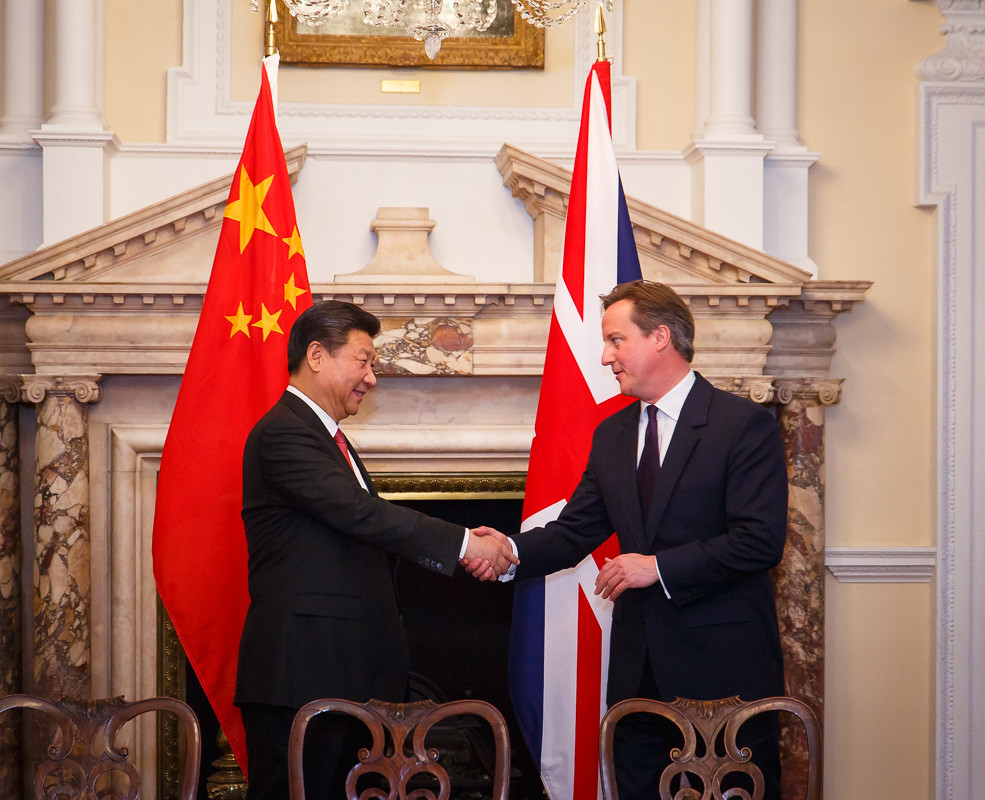
As so often in politics, politicians must strike the balance between moral outrage and managing our economic dependency. Few leaders illustrate this better than David Cameron, who heralded a ‘golden era’ for Sino-British relations, and in pursuit of closer relations, took Xi Jinping for an awkward pint of bitter in a Buckinghamshire pub. Xi’s pub charm must have worked as despite multiple prior warnings from the national security services, the state-owned China National Nuclear was commissioned to build the Hinkley Point C civil nuclear plant.
Today, that same balancing act extends to Britain’s universities. China’s influence on campuses is both financial and political. Chinese students make up the largest group of international students in the UK, contributing billions of pounds to the higher education sector each year and to university’s vibrant community. Yet, according to Amnesty International, Chinese students involved in political activism on campus frequently find that they are harassed and subjected to threats against their families in China.
Worry has also arisen from China’s application to form a ‘super-embassy’ in London. China bought the site of the proposed new embassy, at Royal Mint Court, for £255 million. There has been concern about the site’s proximity to fibre optic cables carrying data of financial institutions in the City of London. Instead of outright denying China their super-embassy, as advocated for by the Conservatives and Liberal Democrats the deadline has been delayed to the 10th December. In response, China has warned the UK of ‘consequences’ if their application fails to go through.
If the Chinese embassy is permitted to operate without greater scrutiny or consequence, it signals more than just diplomatic restraint, it reflects a government increasingly constrained by economic dependency and geopolitical caution. The decision risks projecting an image of Britain as hesitant to challenge potential espionage activities for fear of jeopardising trade and investment ties with Beijing. In doing so, it raises uncomfortable questions about whether economic pragmatism is now taking precedence over national security and democratic integrity.
When dealing with authoritarian leaders, British politicians should not forget the lessons from early diplomatic efforts with President Putin. Tony Blair’s belief that he could do business with Putin exemplified a catastrophic underestimation of power and intent. Pragmatism revealed itself as appeasement. In hindsight, those efforts at conciliation achieved little, Russia has since violated international law, invaded its neighbours, and even carried out poisonings on British soil with impunity. The failure to recognise the limits of diplomacy with autocrats should serve as a caution to the current Labour government.
Further parallels can be found in the British government’s anxiety to temper criticism of both China and Russia’s actions in order to prevent alienating the nations’ leaders. In 2000, Tony Blair and other Western leaders, held back from expressing concerns of civilian deaths during Russia’s campaign against Chechen separatists, prioritising diplomatic cooperation over moral clarity. Now, a similar hesitation surrounds Britain’s response to China’s treatment of Uyghur Muslims in Xinjiang.
In both cases, moral condemnation has been tempered by geopolitical calculation and the prioritisation of closer economic ties. This risks eroding Britain’s credibility on human rights.
For the Labour government, this is the dilemma writ large: how to defend Britain’s democratic values without undermining its economic stability? Starmer has assured the British public that he won’t be pushed around by China. But, as the espionage case and embassy dilly dallying shows, walking that tightrope proves far easier to promise than perform. If the Prime Minister is to avoid repeating the mistakes of past appeasement, he must learn from Blair’s misjudged faith in Putin’s goodwill. If not, history will repeat itself.
For more international politics analysis, click here.
About the author