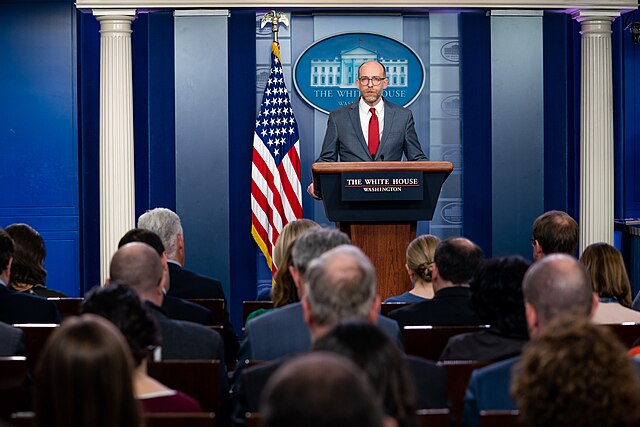
Staff Writer Woody Jeffay analyses how Russell Vought, the little-known architect of Project 2025, became one of the most powerful figures in Trump’s Washington.
On 2nd October, the second day of what would become the longest federal shutdown in American history, Donald Trump posted an AI-generated video set to Blue Öyster Cult’s Don’t Fear the Reaper. In the video, Russell Vought appears as the Grim Reaper, soundtracked to the lyrics: “Russ Vought is the reaper. He wields the pen, the funds, and the brain.” The shutdown would last another 41 days.
The video looked like another typical piece of slop from Trump’s Truth Social account – on which he sometimes posts hundreds of times a day. The post had all the hallmarks of one of his posts – a bizarre AI-generated video celebrating a policy that ultimately sets the country back, but for many, this was the first time they had heard of Russell Vought. He’s an unassuming-looking guy, soft spoken, and lacking the social media presence of Trump or many of his allies. So, who is this grim reaper? Who is Russell Vought – and why have some described him as the “shadow president”?
Vought’s influence within the Trump administration traces back to April 2017, when he was appointed deputy director of the Office of Management and Budget (OMB). He now runs the agency as its full-fledged director. With nearly 500 employees at its disposal and an annual budget approaching $150 million, the OMB is the largest office within the executive branch and one of the most powerful, responsible for funding and implementing the agenda set forward by the president.
For conservatives like Vought, a crucial goal is to consolidate all executive power into the hands of the President – a controversial objective known as unitary executive theory that has been a staple of American conservatism since at least the time of Reagan. In pursuit of this aim, during Trump’s first term, Vought challenged the independence of multiple federal agencies, particularly the Departments of Education and Justice. His crusade against Critical Race Theory and “trans ideology” in schools, as well as his steadfast opposition to growing civil unrest, led to his determined efforts to cut funding for education and to increase the executive’s power against protestors – specifically, Vought argued for providing the President clearer authority to deploy the military against demonstrators.
Between Trump’s terms in office, Vought became a central promoter of Trump’s false stolen election narrative. He founded the Center for Renewing America, a think tank dedicated to combating the teaching of “woke agendas” in schools. He also played a critical role in Project 2025 – a sweeping, conservative policy blueprint intended to push a future Trump administration sharply to the right. In their 920-page plan, the project outlines measures such as dismantling and defunding executive agencies, taking charge of many others, and firing huge numbers of civil servants to be replaced with partisan loyalists.
Project 2025 also seeks to advance a highly conservative social agenda. Vought himself is a self-described Christian nationalist, and the plan outlined by Project 2025 involves the mass deportation of illegal immigrants, the rolling back of anti-discrimination legislation against LGBT people, and the removal of environmental regulations, among many other conservative policies.
Project 2025 is not just about the year 2025. It serves as a long-term strategy for how conservatives can entrench their power within the executive for decades. Its proposals – reducing agency independence, replacing career civil servants with political appointees, and leaning heavily on the judiciary – aim to reshape the federal government in ways that will long outlast Trump’s premiership. Many analysts describe the agenda as democratic backsliding and believe it will greatly weaken American democracy and allow the right great liberty in pursuing the policy that they desire for years to come.
Vought’s explicit aim is to create “shadow departments” – slashing their funding, taking charge from the top, and staffing them with loyalists; Vought wants these institutions to be easily controllable by the president and his close allies. In his role as part of Project 2025, Vought was involved in the more behind-the-scenes aspect of preparing for Trump’s second term, producing hundreds of policy packets and executive orders for Trump to implement as soon as he came into office. Now at the heart of the Trump administration, Vought’s influence has become clear as the policy outlined in Project 2025 is enacted.
In his return to the OMB as director, it’s no surprise that Russell Vought has been described as the “shadow president.” He is seen by many as the engine in Trump’s regime – wielding command of its policy direction. While, of course, Trump is the face of the administration, it seems much of its momentum comes from the almost unknown MAGA apparatchiks, of which Vought seems to be the most influential.
It makes sense then that Vought was portrayed by Trump as the reaper of the executive branch. It’s his handiwork that’s helped gut many government agencies, led to the firing of thousands of civil servants, and helped orchestrate the longest federal shutdown in American history.
What’s ironic is that Vought’s mission in returning to government was to destroy the deep state. I don’t believe there is a deep state; it’s a useful bogeyman for the hard-right, but if Vought succeeds, a real deep state – a shadowy group of loyalists entrenched in the government – may be exactly what he creates.