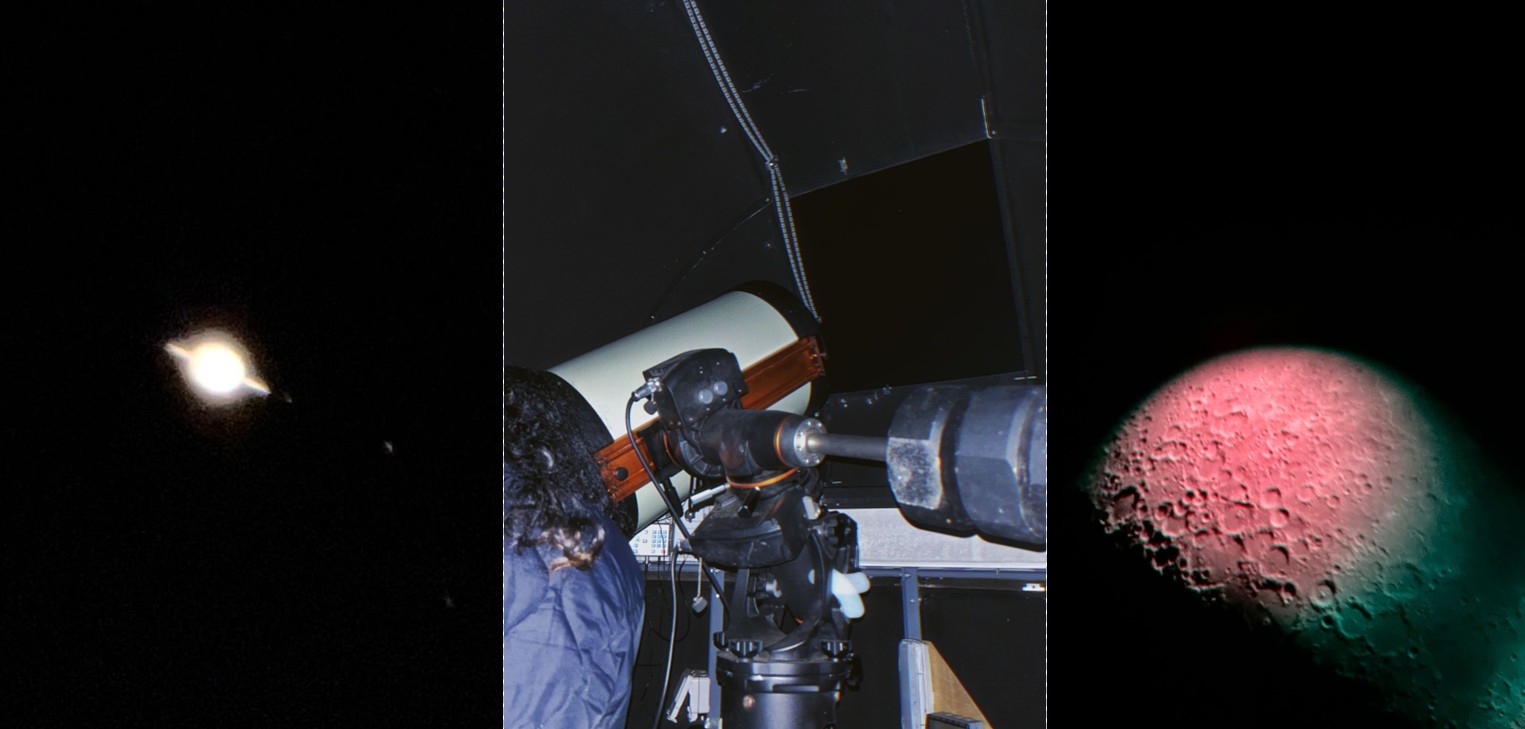
KCL Astronomica held their first observation session of this academic year on 29 October. Professor Malcom Fairbairn of the Physics department notified the president of the society, Thomas Bolton ,that the skies would be clear that evening to test out the University telescope for the first time this semester.
The invitations were exclusive, as this was the first time up on the roof of the King’s Building. At 19:30, we made our way to the roof, walked past the skylight of the Old Anatomy Lecture Theatre and into the observatory where the telescope (Celectron C14) is kept.
Members of Astronomica were led up in twos from the ‘waiting room’ to the dark domed observatory where they could view Saturn, Messier 2 and the Moon.
Messier 2 is a globular cluster, a large group of stars which are held closely together by their own gravity. These systems are too small to become galaxies but show interesting interactions between different star systems.
Messier 2 lies in the Aquarius constellation. At 175 light-years across and holding 150, 000 stars, it is one of the largest and oldest globular clusters we know of.
With Saturn’s rings clearly visible, it was astonishing to even be able to see the faint dot of one of its moons not far off.
The Moon in all its glory, with craters and highlands, featured a gorgeous red glow, which Malcolm explained was likely caused by Earth’s atmosphere interfering with the telescope’s path of vision.
Now that they are more familiar with the set-up of the telescope observation sessions, Astronomica hopes to hold events open to more members of the society so that London’s night sky can be enjoyed by all who might be interested.
“This would not have been possible without Professor Fairbairn who is in charge of the telescope and was keen to show everyone the ropes. I hope we can collaborate again soon. The challenges of stargazing in London are always present and this is one of many ways we can fight back.” – KCL Astronomica
Astronomica has held stargazing events with smaller telescopes, but now that they are more familiar with the setup of KCL’s observatory, they plan to also hold large telescope events in the future.