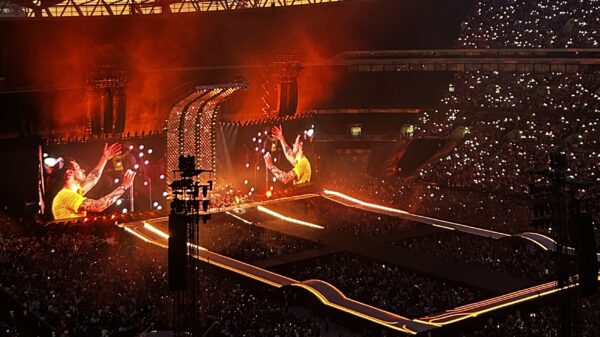
Staff Writer Govhar Dadashova reflects upon both the artistic and political influence of Olivia Rodrigo’s music.
It can be easy to overlook the political nature of Olivia Rodrigo’s music. Her painfully self-aware lyrics on growth and heartbreak could seem antithetical to discussions of racism or political engagement. After all, how does an album like “GUTS” speak to much more than 20-year-old angst? However, I would argue the complete opposite. Whilst politics can often feel like something that happens on a big-picture level, this is not the entire story.
It certainly exists within international treaties, economic negotiations and summits led by world leaders. I cannot deny that unless your last name is Trump or Sunak, you will probably not find yourself in the morning news. But politics is deeply personal and something that we experience every day. It is messy and chaotic, spilling outside of the lines set by academic terminology or poll statistics. I think that individuals shape politics with their lived experiences. They are political just by showing up in the world. The clothes you wear, the friends you surround yourself with and the stories you tell yourself. Politics is as much about narratives and how we perceive ourselves as about big-picture events. Thus, what is most important and what is most personal to us is the key to understanding politics.
And there is nothing more vulnerable than putting pen to paper and exposing your innermost thoughts via music to the entire world. Musicians are nothing short of brave and inspiring for being able to do so. Song lyrics can sometimes articulate our thoughts better than carefully crafted PR speeches. Big-picture events can feel out of our reach, but music brings them closer. They make our feelings more tangible and coherent, allowing politics to feel more accessible and near. They can provide a platform, a space for us to express our emotions – which we need if we are to understand why people make certain decisions.
When actors lose their connection to emotions, they lose their authenticity. Being rational is valuable, no doubt. But politicians should not forget that rationality demands a consideration of individual feelings or interests. Politics does not mean ignoring valid concerns because they are too difficult to deal with. We need to embrace the discomfort. We need to talk about taboo topics. We need to make people feel like politics is for them.
To clarify, I do not think a punk rock style of government is what politics needs or wants. It is the openness and honesty in her lyrics that speak to me.
If politics is about how we show up in the world, then Rodrigo is showing up with a veritable bang. She has skyrocketed to stardom with her debut album “SOUR” and used her music as a cathartic tool. Her fame is awe-inspiring in an industry that has criticised female musicians for being too emotional. She has created more representation for female Asian-American artists, providing a step in the right direction. Her lived experiences have enabled her success. The personal is political, to quote feminist movements from the twentieth century.
Victorian poems like “The Angel in the House” by Coventry Patmore might have praised meekness and blind obedience in women. However, Rodrigo embraces being loud, making mistakes and acting imperfectly. The public and personal spheres collide in her music – their reverberations have travelled across the globe. Shattering expectations of what a ‘good’ woman looks like is long overdue. It is no longer the case that ambition is good in small doses, but too much is lethal for women. Her list of record-breaking milestones proves otherwise.
Ultimately, one cannot deny that male musicians can get away with more than their female counterparts. Think of Justin Bieber and Ed Sheeran waxing lyrical about their romantic relationships without facing nearly the same level of criticism.
Rodrigo has exemplified how thinking outside the box creates opportunities for creativity and connection with the audience. Likability is a tireless and unrewarding pursuit for women in all industries. The singer eschews that goal in favour of being herself–even when that means being painfully honest (in songs like “vampire”) and talking about difficult experiences. Music allows her to blend the personal and political spheres.
For example, singing about her ex-boyfriend gaslighting her in a relationship with an age gap turns into something political. It forces the listener to think about unequal power dynamics. The listener then considers how society glorifies older men pursuing much younger women. All of this stems from one personal story. And it might seem tangential, but it connects to something bigger than one individual, something systemic.
Political structures shape our experiences of love, just as with other emotions. Love is not apolitical or separate from ideas of patriarchy or sexism. It is interconnected with such ideas and affects how relationships function. Lived experiences change how we show up in the world and how we show up in relationships. Rodrigo not only appreciates that fact but weaves it into her narrative. That is what makes her songs meaningful.
People relate to her music because they can empathise with her emotions, even if they have not had the same experiences. Separating the personal from the political is a worthless endeavour. Instead, Rodrigo proves the advantages of combining both spheres.
The exciting news is that her career is still ahead of her. There is no doubt that she will continue to impress critics and listeners alike with her powerful songs. It is a testament to her influence that she spoke at the White House daily briefing in 2021 to back COVID-19 vaccinations. Rodrigo might not be a political actor in the traditional sense, but her impact is undeniable. The future is hard to predict. However, I would gamble that her White House appearance will not be her defining political achievement. It will be the way that she encouraged fans to embrace their lived experiences and emotions.
About the author