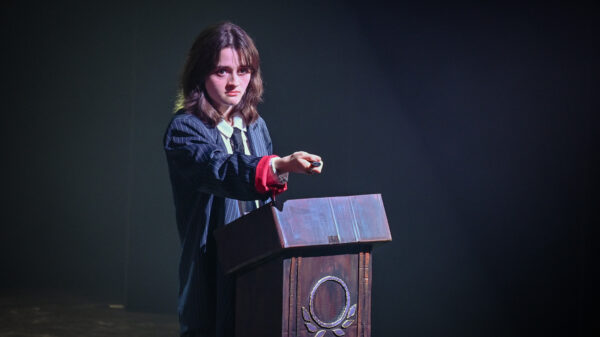
Staff Writer Naz Karadede reviews West End’s controversial adaptation of the book “A Little Life” at the Harold Pinter Theatre.
TRIGGER WARNING: This article contains references to sensitive topics such as sexual abuse, self-harm, and suicide.
“A Little Life” by Hanya Yanagihara has long been one of my favourite books. The book became notorious after its publication in 2015 for its relentless and, at certain points, unbearably graphic depiction of child abuse, sexual assault, and self-harm, and more recently, gained considerable fame on TikTok as one of #BookTok’s most popular books – and guilty pleasures. Yet, despite its traumatising and morbidly depressing subject material, it still remains, in my opinion, a heart-breaking and most definitely unforgettable story about the importance of friendship and love.
So naturally when I heard that a West End adaptation of the book was coming to the Harold Pinter Theatre on 25 March, I knew that I most definitely could not miss out. And I was lucky enough to secure a standing ticket. Boy was I in for a ride.
Given the nature of the book’s subject matter, I knew that the play would not be an easy watch. The book tells the story of four college friends – Jude, Willem, Malcolm, and J.B. – and their lives and relationships with each other. It specifically focuses on the life of Jude, an esteemed New York lawyer who was sexually and physically abused for most of his childhood and teenage life, and who since a very young age has resorted to self-harm as a destructive coping mechanism. His childhood trauma and the physical ramifications of his past abuse continue to overshadow his adult life and relationships, so much so that fresh traumas that cause him to relive the past culminate in violent outbursts of self-harm and numerous failed suicide attempts.
Ivo van Hove’s West End adaptation does not miss out on anything. Initially devised and directed by van Hove in Dutch, and premiering in English at the Harold Pinter with a script written by Yanagihara herself, the play stays true to the book’s plot – and with unapologetic realism. From nudity to painfully graphic scenes of self-harm using fake blood to shockingly vivid and realistic depictions of physical and sexual abuse, it has it all. In the span of 3 hours and 40 minutes, the audience is made to live and relive every trauma with Jude. The small, claustrophobic layout of the stage and the ominous music played throughout the play further serve to confine the audience to what seems like an endless depiction of the protagonist’s misery and suffering. And to highlight to the audience just how trapped in his past Jude really is.
Bearing in mind the limited time of the play and the structure of the plot, it does indeed at times feel like an extensive, relentless and at certain points distressingly melodramatic run-through of all the trauma that Jude experiences throughout his life. Critics have pointed out that the play focuses too much on abuse and suffering, which limits its scope for delving deeper into the intimate relationships portrayed in the book transforming the other characters, especially Willem, JB and Malcolm into marginal, fleeting and transient actors in Jude’s life. The result is that we, the audience, become mere spectators to what seems like never-ending pain and suffering. We become passive witnesses to violence and inhumanity that are unimaginable for most of us, with little in the form of relief. And in the process own threshold for second-hand pain is tested.
The play is massively discomforting at best and ruthlessly agonising to watch at worst. I would not recommend watching it to anyone who has experienced any trauma similar to Jude’s, for it can be very triggering. Nevertheless, given the duration limits and how central Jude’s trauma is to the book’s plot, it is unsurprising that van Hove chose to condense the plot and make trauma the central focus of the play.
James Norton, the actor who plays Jude, does an absolutely phenomenal job of bringing the character to life. Best known for his role as Tommy Lee Royce in “Happy Valley”, Norton plays the character of Jude with such commitment and dedication that one cannot help but wonder how he manages to convey a character as damaged as Jude with such a convincing authenticity once every day. The audience is immediately won over by his portrayal of Jude’s inner turmoil and childish vulnerability, so much so that we cannot help but feel pure sympathy for him throughout the show. Some have called it his “career-defining performance”.
The supporting actors also do a fantastic job at bringing the other characters to life – Luke Thompson as Willem, Omari Douglas as JB, Zach Wyatt as Malcolm and especially Elliot Cowan who plays Jude’s main abuser, Brother Luke, with chilling persuasiveness.
Overall, the play has critics widely divided. Whilst some have called it “deeply unsettling” for its graphic depiction of abuse and self-harm, others have praised the play for the brilliant performances of the actors. My verdict is this: it is just like James Norton’s performance – heartbreaking, provocative and unforgettable.
About the author