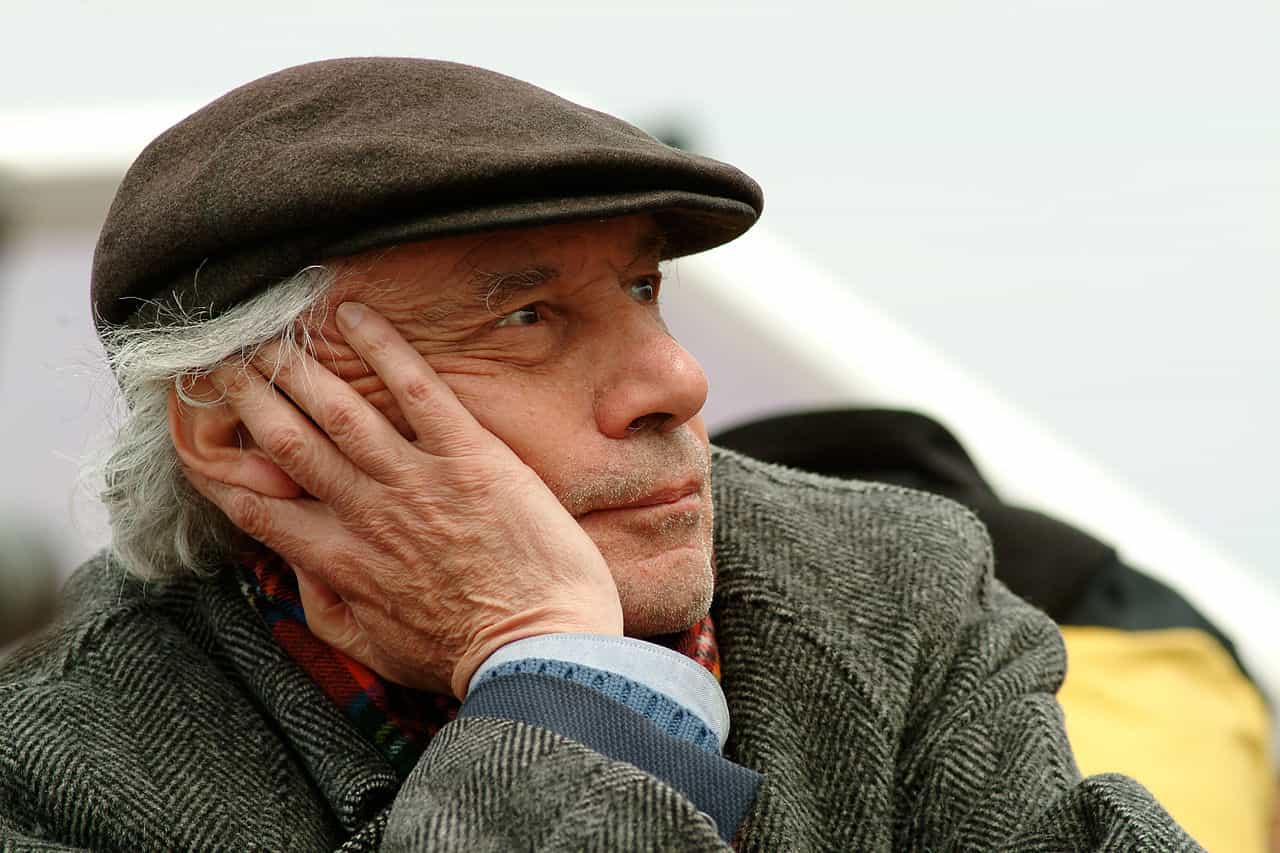
Roar writer Joseph Israel on how Jacques Rivette’s cinema allows us to appreciate the experience of slowness.
Many studies have already warned of the dangers posed by passive hyper-consumption of information and digital addiction. Aggravated attention disorders, sleep and vision disturbances, etc.: it has already been known for years now that spending hours on social media does not do anyone any good. Nevertheless, I like to believe that nothing is ever really lost in this case and that we can always (re)learn how to concentrate, cultivate our curiosity, and get rid of the hold that hyper-connection has on us. If there are many ways to do this, I would like in this short article to recall Jacques Rivette, the emblematic French director of the late new wave, whose work was built by constantly working – among other things – on the experience of slowness.Â
“Filming slowness” is to translate life as it is, to re-transcribe the movements, intuitions, and the slightest gestures that shape human relationships. Thus, most of Jacques Rivette’s films exceed 3 hours, and if my humble favourite, “La Belle Noiseuse” (1991), comes to tickle the 4-hour mark, it is nothing compared to the monster “Out 1″ (1971) of 12 hours and 53 minutes. It may seem frightening, even inconceivable, to spend so much time in front of a film, but it’s perfectly normal. Rivette is not a very accessible director, but, to all film lovers, he is definitely well worth the detour.
In “La Belle Noiseuse,” for example, the viewer may be surprised by the length of the scenes where Edouard (Michel Piccoli) draws Marianne (Emmanuelle Béart); but this is a real aesthetic hypnosis characteristic of Rivette’s sensitivity, which stimulates the senses not by trying to represent them or imitate them, but by truly experiencing the sensation, the truth of the time experienced. In terms of form, the shots are fixed or are part of a slow camera movement, but rarely instantaneous, immediate; in short, life is not consumed by a thirst for information. By listening for long minutes to the intoxicating sound of charcoal on paper, one can let go of the feeling of impatience, cause of low attention, to then reach a state of active contemplation, where the senses, imagination and intellect intermingle. To experience slowness is to remember what patience is, it is to allow oneself to depart momentarily from the moving world. It is to live Art individually, independent of the hyper-connected consciousness polluted by an incessant flow of information.Â
Jacques Rivette, therefore, invites the viewer to participate organically in the creative process of his film work, allowing, in my opinion, a step back from the passiveness of scrolling, if one finds the motivation to experience his films.Â
About the author