From his vibrant displays of light glinting off the sea to shadowy blurs of battle scenes, JMW Turner’s full range of skill is represented in Turner’s Modern World, an exhibit recently opened at Tate Britain.Â
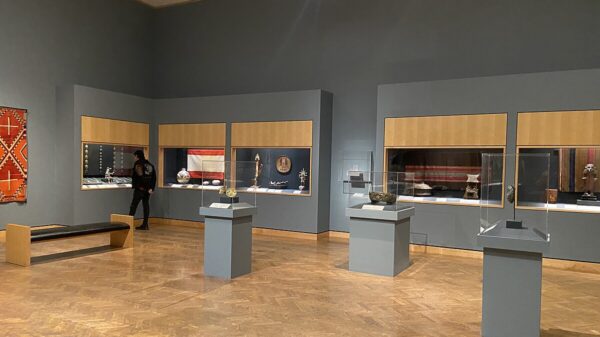
While not necessarily a transportive experience, Turner’s Modern World provides viewers a chance to step into Turner’s mindset by offering looks at his sketches and unfinished paintings, works by his contemporaries, and a twisting progression of his art through time and historical moments.
From its outset, the exhibit highlights Turner’s unusual inclination toward what became Impressionist and Expressionist styles to depict a world increasingly populated by metal and machinery. His evolution toward that style and subject matter can be found on the exhibit’s walls scattered among his better known oil and watercolour paintings. By placing unfinished paintings and faded sketches amongst Turner’s more famous pieces, Turner’s Modern World highlights the non-linearity of an artist’s evolution and the interplay of an artist’s interests with the world around them.

An up-close view of ‘Peace — Burial at Sea,’ typical of Turner’s repertoire for its maritime theme and use of colour.
Turner’s graphite sketches often pictured industrial subjects, like his View of Cyfartha Ironworks from the Brecon Road. While this sketch, produced in 1798, and others like it, may not have the same impact on its observers as Turner’s roaring depictions of battle scenes or ships at sea, it offers us an insight into Turner’s mind. Turner, early on in his artistic life, dedicated himself to exploring the modern, industrial world as it unfolded around him.Â
The exhibit’s smattering of unfinished paintings or sketches serves not only to emphasize Turner’s choice of subject matter, but to highlight his process and evolution as an artist. In A Disaster at Sea, noted in the exhibit as being unfinished, Turner’s play with light in the painting brings an observer’s focus to the cherubic, small figures of women and children as they descend into the ocean, left to drown. According to Tate Britain, the subject matter of the painting was the 1833 wreck of Amphitrite, during which “the ship’s captain abandoned his cargo of female convicts.†Once again, exhibit-goers can see how Turner grappled with culminating issues, in this case maritime tragedies.Â

An up-close view of women and children drowning in Turner’s ‘A Disaster at Sea.’
One of the ways the exhibit sharpens the relationship between Turner’s mind and the world he lived in is by offering the works of his contemporaries for display. For instance, in a room dedicated to his earlier works, the exhibit presents other artists’ representations of industrial subjects. A few of Philip James De Loutherbourg’s works line the walls among Turner’s, depicting steam-engines and iron furnaces. The small array of Loutherbourg’s works – an early contemporary of Turner – places observers more soundly in the world Turner lived in. By seeing glimpses of the works that were likely to have influenced him, the exhibit creates a more complete picture of Turner’s process.
Almost at the end of the exhibit lies Turner’s arguably most famous work, Rain, Steam, and Speed, on loan from the National Gallery. In context with the twisting interplay of Turner’s external world with his inner mind offered by the preceding works of the exhibit, Rain, Steam and Speed guides observers toward the thrilling climax of Turner’s expressionist painting style with his modern, industrial subjects.
Turner, best known for his expressionism, is represented in Turner’s Modern World as a holistic artist fully immersed and interested in the changes of his time. The emphasis of this display is decidedly on the relationship between his art and political/historical moments and changes, but Turner’s singular way of playing with light, colour and shadows is hard to miss. Exhibit-goers, above all, will be left with a strong impression of the vibrance of Turner’s work.Â
Those interested in Turner’s Modern World can visit the exhibit from 28 October 2020 until 7 March 2021.
About the author