Staff writer Louis Palmer discusses and analyses a talk delivered by former Australian prime minister, hosted by the King’s College London Politics Society
Look back a little and you’ll find that, despite the slash and burn tactics employed by politicians when seeking power, those who have had it – and lost it – tend to hold their tongue. Politics is a tribal sport, in which most grudges usually take a back seat to party loyalty. Tony Blair had nothing bad to say of Gordon Brown’s stunted premiership, regardless of their tabloidesque divorce, keeping quiet even when his successor lost an election that, in his heart, Blair knew he could have won. And when, first as Foreign Secretary and then as Prime Minister, Boris Johnson followed the maxim of “F*ck business” to guide Britain through its most fragile and economically vital Brexit negotiations, David Cameron stayed mute, despite it being widely understood that his thoughts on the matter followed the maxim of “F*ck Boris”.
Malcolm Turnbull’s approach to retirement differs somewhat. Having been unceremoniously “defenestrated” by his own MPs, as he himself put it in his 2nd February talk to Kings’ College London Politics Society, Australia’s 29th Prime Minister has spent the past eight years refusing to follow any conventions of partisanship or restraint. Rather, Turnbull has emerged as one of the most outspoken and scathing conservative critics of the populist right in Australia. And, with a bluntness that angers so many of his former colleagues, this means taking an axe to those now in charge of his own party: the Liberals.
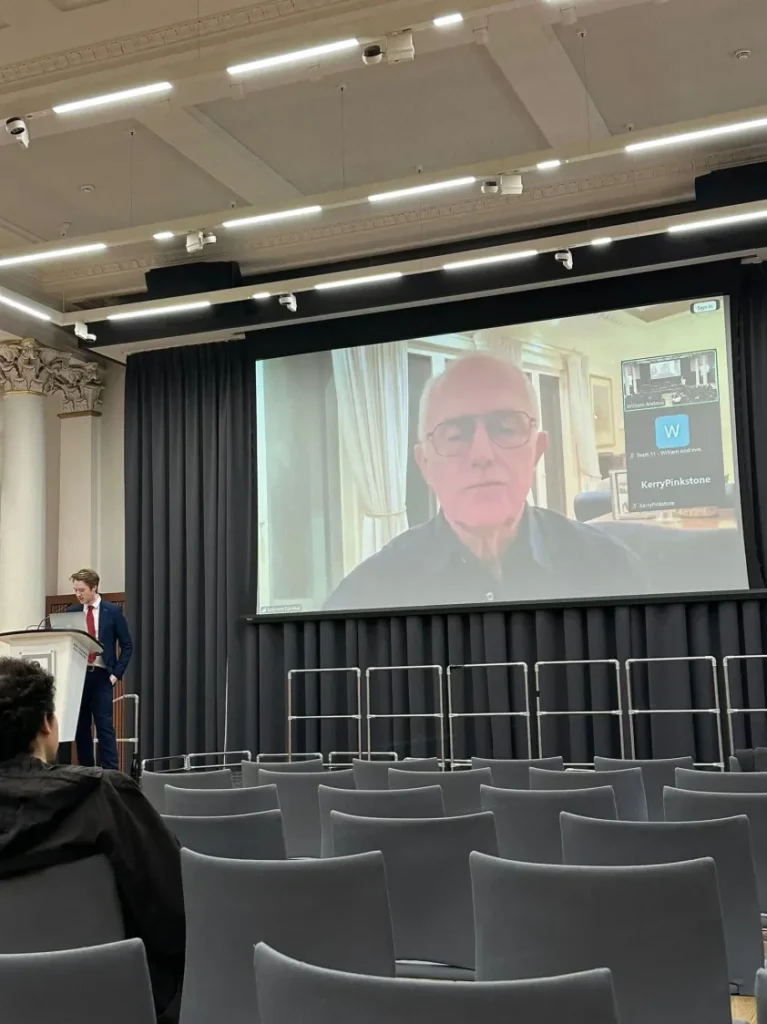
Since its unexpected triumph back in the 2019 general election, the Liberal Party has moved ever further to the ideological right, and ever further into political irrelevance. Two squandered elections and four failed leaders later, the populist rot shows no sign of abating. It was against this backdrop that Malcolm Turnbull joined the King’s College London Politics Society, via Teams call in order to make clear the situation that his party now faces.
When Kings’ College London Politics Society asked for his thoughts on the direction that the traditionally moderate and pragmatic Liberal Party has moved towards since his abrupt and premature departure, Turnbull offered the following assessment:
“My party, ever since I was defenestrated in 2018, has been seen by many voters as having gone further and further to the right… it has brought them electoral failure. They’re creating a vacuum and somebody else will fill it in due course.”
The Collapse of the Liberals
In Turnbull’s post-mortem analysis, the Liberals’ electoral slump stems entirely from their abandonment of serious politics. His party has been steered to diminishing returns by a series of unworthy leaders, each one representing a decline from their predecessor.
When Turnbull’s premiership was knifed, his assassin took the form of Scott Morrison, a former marketing director, evangelical Christian, and fossil fuel fan(atic).
To better illustrate the man: Morrison, as Treasurer, once held up a lump of coal in Parliament and reassured climate-conscious Labor MPs not to worry, because it wouldn’t hurt them. Any dismissal of the effects of climate change by those on the right draws particular ire from Turnbull, who reviles the coal lobby that holds such a grip on his party. Rather, he advocates for the expansion of renewable energy infrastructure in Australia – in his mind, a “fantastic” opportunity for cheap, clean power.
The public having inevitably tired of his regressions, Morrison was cast out of the leadership in turn after the Liberals’ 2022 election defeat, being replaced by the thuggish ex-cop Peter Dutton. With this, the Liberals lurched even further to the right, and, according to Turnbull’s testimony, even further down their path of decay. “Mr. Dutton no longer has a seat in Parliament because his style of right wing politics was so catastrophic”.
Dutton, unlike Turnbull, was not afforded the privilege of resigning from his seat in the House of Representatives, being ‘defenestrated’ by his own constituents in favour of the Labor Party candidate after 24 years in office. Such a knifing only comes as the deserved consequence for having prioritised populist discourse over what are, in Turnbull’s mind, the bread-and-butter issues that actually matter.
Despite widespread consternation at the rising cost of living causing problems for Anthony Albanese’s Labor government, when election time rolled around Turnbull believed that “the public was forced to consider the opposition… and ran back into the arms of the Labor Party with such a vengeance that [Albanese] considerably increased his majority”.
A Self-Sustaining Cycle
When yet another Liberal leadership contest was staged last year, it was Turnbull’s former Health Minister Sussan Ley who stepped up to take the fall, and to continue the Liberal Party’s evacuation from political reality. A conservative in the Jenrick mould, Ley seized upon the decline of moderation within her party and set out to exploit it. She made the switch from a self-proclaimed ‘progressive’ conservative – a vegetarian, a feminist, and an outspoken republican – to a stalwart of the Liberals’ populist right wing. Turnbull believes that it is she who may well end up finishing the job of killing the Liberal Party that Morrison began, and Dutton continued.
In January, having been bled dry of any patience to put up with Ley’s antics, her National Party electoral coalition partners walked out for good. Turnbull’s verdict? This was the justified “high price” that the Liberals paid for “running off to the extremes” by prioritising “bullshit” over serious policy, and Ley only has herself to blame.
It’s not just the cravenness of the modern Liberal Party at which Turnbull despairs, but its stupidity, and the notion that Albanese is somehow responsible for failing to prevent two Australian citizens from carrying out an antisemitic terrorist attack – using legally acquired firearms that they had legally transported, no less – is very stupid indeed. As Turnbull said on Monday, “no admonitions about the evils of antisemitism from the Australian Prime Minister would have discouraged these two extremists”. And no person benefits from the Liberal Party’s inane and desperate point-scoring other than Albanese himself – “the luckiest Prime Minister” in Turnbull’s memory, because, having seen off Dutton and now Ley, he can always rely on the opposition “to blow its brains out”. This assessment has since been proven sound; following in the footsteps of Morrison and Dutton, Ley has since been disposed of in turn, being replaced by the even more egregious Angus Taylor.
An International Affliction
When it comes to the culture war politics that has metastasised over the last couple of decades, Turnbull’s message is no different. He warns against incorporating such a message into his party’s platform – this would only prove a futile effort to neuter the populists for whom these issues are their lifeblood; “If you’re just going to compete with culture war type slogans, all you’re going to do is increase the salience of the issues on which those populists depend”.
As a consequence of their rightward shift, the Liberals have alienated their well-moneyed, suburban voter base. Almost all of “the safest, most affluent, blue ribbon Liberal seats in Australia” have been lost to Labor and independent candidates, including Turnbull’s own. And all they have to show for their efforts is the rocketing popularity of nationalist Pauline Hanson, who – along with, Turnbull added, her clones in seemingly every other country – is poised to make striking gains amongst the rural right.
By no means is Turnbull’s revulsion at populism limited to domestic affairs; much of his talk was devoted to his excoriating assessment of the Trump administration, in the United States. In this regard, he particularly emphasised the Republican Party’s movement to a position so extreme that most international politicians, including Turnbull himself, once thought inconceivable. To say that Donald Trump believes that might is right “is like saying that the Pope’s a Catholic” – a stark deviation from his first term, in which a “revolving door” of officials and complete lack of any political strategy neutered Trump’s almost-entirely absent agenda.
Buffeted around seemingly at Donald Trump’s whim, and facing the sharp end of insults and, worse still, a slate of entirely unprecedented tariffs, Turnbull believes that for Europe to thrive, it must strike out on its own.
“The Europeans are aware of the need to deal with likeminded countries other than the US”, even if, right now, Europe “does not have an independent trade policy”. In the place of America, “likeminded countries”, such as Australia and Canada, will likely be to where the EU turns to secure its economic future. For all affairs are now defined by the Trump administration’s relentless belligerence (indeed, its belligerence as a policy). With this in mind, the only known certainty is that, in figurative terms, the Atlantic will continue to widen.
“I remember discussing this with Xi Jinping”, Turnbull recalled. “He thought Trump would normalise… that didn’t happen”. The inherent irony of this situation – of Trump’s decimation of America’s allegiances, of the sheer “loopiness” of his rejection of wind and solar power – didn’t go unacknowledged. “You sometimes wonder whether his objective is to Make China Great Again.”
A very ugly prognosis
Sooner or later, but in all likelihood later, the Liberals will be forced to look their decline in the face. And when they do so, Turnbull believes, their attention will be arrested by only one, obvious solution; to pivot back towards the ideological centre, where “there is a market opening up” for the kind of fact-based, rational politics that they once so devoutly embraced. But no timeframe yet exists for this renewal, and nobody can say who will step up to correct their course.