

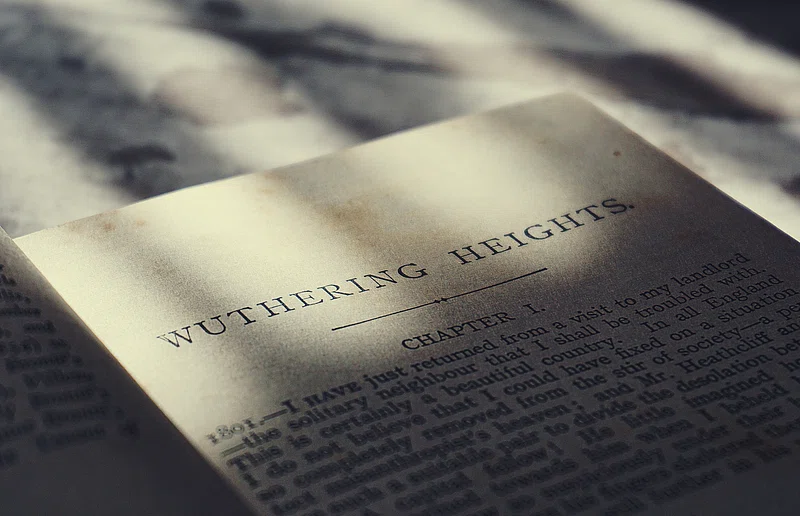
Culture writer Lamisa Worthy reviews Emerald Fennell’s divisive “Wuthering Heights” adaptation
From its bold contemporary take on costume and makeup to the controversial casting of Jacob Elordi as Heathcliff, Emerald Fennell’s adaptation of Emily Brontë’s Wuthering Heights has positioned itself at the centre of cultural conversation well before its release. Such a feat is no small accomplishment, yet if Fennell’s career thus far is any indication, controversy is a seemingly comfortable mode of operation.
Released over Valentine’s weekend, an irony not lost on anyone familiar with the source material, “Wuthering Heights” has proven as divisive as it is visually striking. In the days following its premiere, critical responses have largely fallen into two groups: those willing to embrace Fennell’s creative direction, and those, often devoted readers of the novel, who regard it as a fundamental misreading of the text. The loudest of criticisms coalesce between concerns over the casting of Heathcliff, and the dilution of the novel’s thematic core.
Brontë’s original characterisation repeatedly depicts Heathcliff as “dark-skinned” in appearance, an orphan of ambiguous origin. These details are far from incidental. His racialisation situates him as an outsider within the rigid hierarchies of nineteenth-century England, shaping both the abuse he endures as a child and the violence that defines his adulthood. Casting Elordi has therefore been read by some critics as more than a cosmetic change: it erases an essential dimension of the social hostility and marginalisation that animates much of the plot.
That shift has a domino effect. Heathcliff’s racialisation is not merely a peripheral trait that can be dismissed. By stripping away that context, the narrative shifts from a story about cycles of abuse, colonial anxiety, and racial trauma to one of a thwarted romance shaped by longing and miscommunication.
This recalibration extends to characterisation. Brontë’s protagonists are not designed to be likeable. Heathcliff, brutalised in childhood, grows into a man who inflicts abuse on everyone around him, and Cathy, though with moments of deep vulnerability and love, is volatile, proud, and often manipulative.
Their relationship is corrosive, not aspirational—less a grand romance than a mutually assured destruction pact amidst the aesthetic backdrop of the English moors. And certainly not one to aspire to on Valentine’s Day, unless one’s ideal celebration involves manipulation and generational cruelty.
While Elordi delivers moments of intensity, the screenplay grants Heathcliff a softness that casts him in a sympathetic light, reframing his monstrosity as palatable and “misunderstood”. The result is a figure more wounded than irredeemably brutish—Byronic in posture, but cautiously house-trained. Cathy, too, becomes rather flat. Her spite and ferocity were muted in favour of tragic romanticism.
Even the film’s marketing reinforces this shift. Positioned as the quintessential love story, complete with a remarkably strategic romantic release window, the adaptation leans far too heavily into the commodified aesthetics of doomed passion: longing glances and secret moments and a dutiful parade of will-they-won’t-they that feels divorced from Brontë’s original intentions. But Wuthering Heights is not, at its heart, a love story. It is a novel about violence, race, and abuse. Its Gothic extremity is deliberate: it is meant to unsettle. And that is where Fennell falls flat.
Not to say that there aren’t moments that work. The cinematography is aesthetically striking, and both Elordi and Robbie deliver emotionally moving performances. Even the choice of Charli XCX for the soundtrack, though equally controversial, introduces an interesting tonal register.
Yet these strengths are ultimately let down by a screenplay that appears reluctant to engage with the novel’s harshest implications, marking this adaptation more accessible but also less daring.
Supporters of this critique often frame this as symptomatic of a broader “literary crisis”, an anxiety that canonical texts are being diluted and aesthetisised to accommodate this age of streaming and rapidly shifting trend cycle.
Yet, there is another side to this debate: those who insist that this adaptation can be appreciated on its own terms. This group argues that audiences are over-intellectualising the film. In their view, literature students, or anyone attached to the book, really, risk mistaking fidelity for quality, with their demands for an “honest-to-text” reproduction flattening their ability to engage with adaptation as interpretation.
But when a story so rooted in hostility and moral ambiguity is repackaged and marketed in this manner, something essential is lost. By sanding down Brontë’s extremities, Fennell delivers a version of Wuthering Heights that, though visually compelling and at times emotionally striking, is ultimately rather hollow.