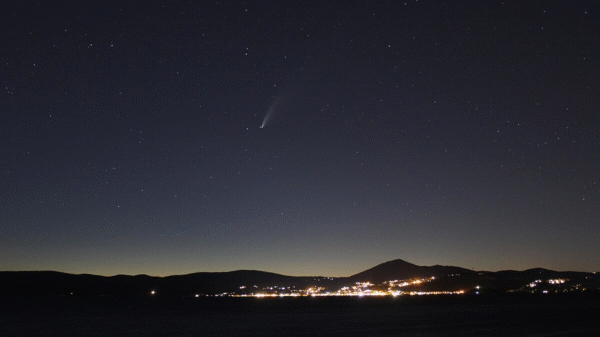
Science editor Anoushka Sinha discusses the discovery of interstellar comet 3I/ATLAS.
In July 2025, the ATLAS telescope discovered a comet had entered our Solar System; the third interstellar object to ever be detected.
The former two interstellar objects to enter our Solar System were 1I/’Oumuamua in 2017 and 2I/Borisov in 2019. This third comet, 3I/ATLAS, will disappear behind the Sun in October and reappear in November. The comet’s tail is growing as it nears the Sun.
Astronomers believe comets form in the gas and dust surrounding new-born stars, before clumping together to form balls of frozen gas and water.
Over the months following 3I/ATLAS’s discovery, researchers have been observing it – and they’ve found some strange things.
By studying the wavelengths of light observed from the comet, researchers from NASA’s JWST team found that the comet has a high amount of carbon dioxide.
“The high-quality spectrum of light measured by JWST is key in studying its properties. In particular, the unusually high amount of CO2 in its cometry gas may indicate that it has been bombarded by UV light and high-energy particles (cosmic rays).”
Dr Jeffrey Grube, Senior Lecturer at King’s College London, specialising in high-energy astrophysics.
It is therefore likely that the comet came from a stellar system which has more carbon dioxide than our own Solar System. In Astrophysics, metallicity refers to whether an object contains elements larger than Hydrogen (the smallest atom). The low metallicity of the comet suggests it may be from the ‘thick disk’ section of the Milky Way galaxy (closer to the centre than us, but still not within the central bulge which surrounds the supermassive blackhole at the centre of the galaxy).
Another study by the Universities of Oxford and Canterbury stated that interstellar objects are the most common objects in the galaxy, but few are observed due to their small size and high speed. 3I/ATLAS “allows us a rare chance to study the product of processes of planetesimal formation around another star”.
In this study, on the velocity and position of the comet, it was found that though it initially seemed feasible that 3I/ATLAS came from the same stellar system as one of its predecessors, it was travelling too fast for that to be the case.
The velocity of the comet also indicates that it is over seven billion years older than both the other interstellar comets and the Sun. For context, our Sun is four billion years old, and the Universe is 14 billion years old.