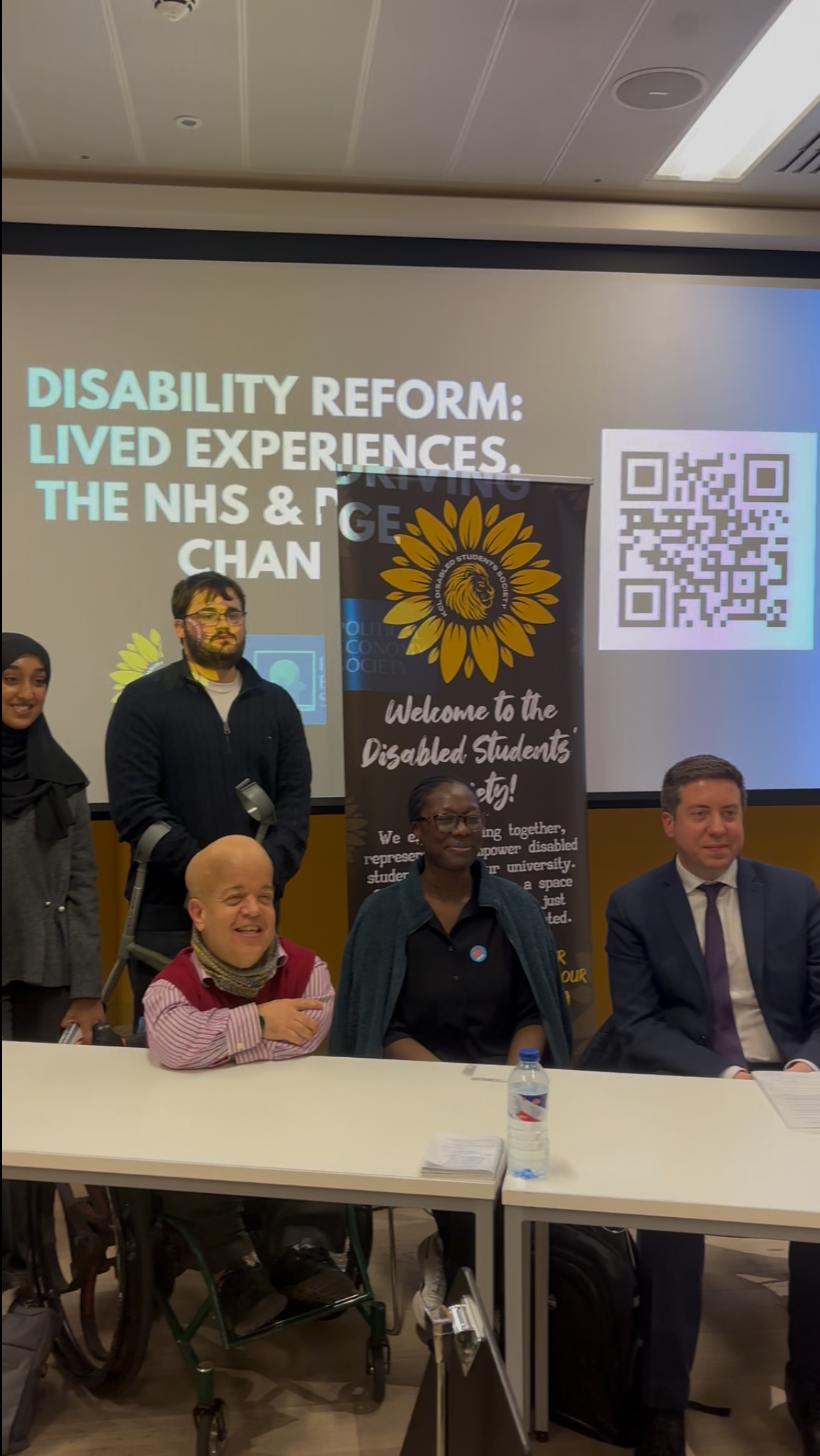
Last week, the Disabled Students Society hosted prominent disabled rights activists, entrepreneurs and Labour MP, Liam Conlon. They discussed NHS Reform, the disability rights movement and the political action students can take to create change.
Speakers Tom Shakespeare, Roki Seydi and MP Liam Conlon discussed how students can create change through writing letters to their MPs, attending events and protests and joining the Disability Rights Movement.
Shakespeare explained that the Disability Rights movement in the UK lost momentum after the legislative wins in 2008, and has lacked direction and unity in recent years.
He urged the audience to look for similarities in the disabled community instead of differences, drawing on recent debates of mental versus physical disabilities.
Additionally, he mentioned that having “safe spaces to talk about how it feels to be different is really important,” as there is a major psychological component to living with an impairment.
Despite explaining the challenges Shakespeare has encountered in his life, he spoke positively and hopefully about the future.
NHS Experiences
Roki Seydi, a tech entrepreneur working to better the healthcare system, mentioned the racial and gender biases existing in the NHS that can have life-threatening ramifications.
She spoke about her experiences in being diagnosed with her disability as a student at King’s College London, and how the Strand GP service dismissed her symptoms, leading to her fainting from a blood clot.
Seydi argued that the patient care in the NHS is lacking; it’s too fast, and patients can be distilled into stereotypes for efficiency. Seydi reminded the audience that disabled people are, “trying to navigate a system that was not built for you.”
Disabled Rights in Politics
Labour MP Liam Conlon directed the conversation to the politics of disabilities, mentioning that he has voted against the recent Assisted Dying bill, but voted for the complete decriminalisation of abortion.
He explained that he felt that the disabled community had not been appropriately consulted in regards to the Assisted Dying bill, and there were factors the bill had not considered.
Conlon identified his main issue with the NHS: waiting times. He explained that, especially for patients suffering from chronic illnesses or physical impairments, the waiting time for surgeries and care was simply too long.
Shakespeare agreed, adding that the palliative care offered by the NHS is abysmal and the access to physiotherapy virtually non-existent in his experience, even after multiple spinal surgeries.
NHS Reforms
Furthermore, Shakespeare and Seydi discussed the privatisation of the NHS and the advantages of an integrative care model.
Seydi proposed that the NHS should be more open to innovation, mentioning that some US healthcare models are more open to implementing new innovative ideas.
Whereas the NHS is not designed to facilitate the implementation of new entrepreneurial systems.
The key message of the event was to inspire students to take chances, create the change they want to see, write letters to their MPs, engage in movements and conversations around disabled rights and try to make a difference in any way they can.
Thank you to the Disabled Students Society for inviting ROAR to cover the event and for the opportunity to discuss and hear from such inspiring activists.
Information about the Disabled Students Society and more events can be found on their Instagram @kcldisabledstudents.