Staff writer Elouise Davies examines contemporary performances of Henrik Ibsen’s plays, through the lens of star power and modernising contexts.
Henrik Ibsen has experienced a recent revival of his plays in the West End. My Master Builder, at the Wyndham’s Theatre over the spring, and The Lady from the Sea, running at the Bridge Theatre this autumn, are two of the newest additions to Ibsen’s theatrical renewals. Both prominently featuring large names such as Ewan McGregor and Andrew Lincoln, but they have also received their fair share of critiques.
The growing importance of star casting
One of the more obvious features of these two productions is the role of stunt casting to generate interest in plays that may otherwise be overlooked as too niche amongst general audiences. Both rely on recognisable actors from film and TV in their new roles on the stage. My Master Builder prominently stars Ewan McGregor in the lead role as Henry Solness, advertising this as his long-awaited return to the stage. Similarly, The Lady from the Sea features Andrew Lincoln making his own return to the theatre, as Edward. Whilst Ibsen is an influential playwright, attaching a large name to revivals addresses the gap between prestige and accessibility; this ensures a further outreach to media, more ticket sales, and a younger audience demographic hoping to see the stars they recognise from their screens.
Although star casting is an important marketing strategy to the staging of more classical works, it can also be its own burden. There is a compelling reason to cast such famous actors, in the fact that they are good at their jobs. They have become widely recognised names through their talent and success. However, this talent is also rooted in the idea they can be too easily recognisable to audiences. A key critique of My Master Builder is the idea that production was constructed around McGregor’s own image rather than that of his character – as a result, audiences see McGregor on stage, not Henry. The eager willingness to see a celebrity’s presence as the main reason to attend a show creates its own downfalls. Too much focus is placed on seeing stars such as Lincoln or Joe Alwyn in The Lady from the Sea, rather than paying to see the show itself. Star casting guarantees a wider outreach to audiences, but risks losing the true meaning of the play.
Alongside the casting of Matt Smith in An Enemy of the People last year, perhaps it is reasonable to suggest contemporary revivals of Ibsen’s works rely on this to both increase engagement with classic literature as well as guarantee success in the risk-averse theatre economy.
Modernisation in revivals
Plenty of productions across the West End that have aimed to revive older plays have done so in a new modern context – beyond Ibsen, this is a common feature of new Shakespeare productions, and various plays directed by Jamie Lloyd. Updating classical texts to provide contemporary relevance to audiences always comes with its own risks – in doing so, it chances upsetting those familiar with Ibsen’s work, whilst also impressing those who are approaching it for the first time in this modern form.
My Master Builder
My Master Builder reimagines the play as a product of celebrated star architect Henry Solness, hosting a luxurious dinner party in the Hamptons. Ibsen’s original play focuses on the maddening desire of Solness, commenting upon the sexual misconduct of powerful men coercing young women, who fall into this trap of abuse due to their impressionable nature. Lila Raicek’s new text changes this into a story of Solness’s privilege and creative exhaustion. The nature of the play shifts from his misconduct, reframing this through the lens of his wife and former lover. Placing this in a modern context allows for commentary to be made on his power imbalance as an attempt at shaming him through recalling the Me Too movement is made by the women he is surrounded by. These women are given more agency as we are allowed to explore the themes of the play in line with modern thinking. In turn, they become far more compelling characters whilst discovering themselves.
The Lady from the Sea
The Lady from the Sea further provides an example of a modernised production that has been moved into a contemporary setting both visually and thematically. Specifically, this takes on the form of moody teenagers, mentions of social media, and a series of pop culture references. These attempts to modernise feel strangely forced into the content of the play and do nothing to add to it, instead only detracting from it. Interactions between characters feel unnatural, with common conversations focusing too much on modern references.
The play is at its best when focusing on preserving Ibsen’s original play – in particular, the mythical pull of the ocean to Ellida, which, whilst lost in the first part, is soon picked up after the interval. Reframing her relationship with a past lover who continues to haunt her in a modern context hints at new social dynamics. Similarly to that of Solness and his student lover, Ellida’s relationship as a young woman with a far older man is thought of in a modern context as a predatory one. Simon Stone’s adaptation also changes the end of Ibsen’s original play, as Ellida is continuously torn from safety and lured into the unknown. Translating this into the modernisation of women, in which women are given the option to leave those who aim to define their lives, Ellida chooses to focus on herself rather than on the men around her.
Experimental staging
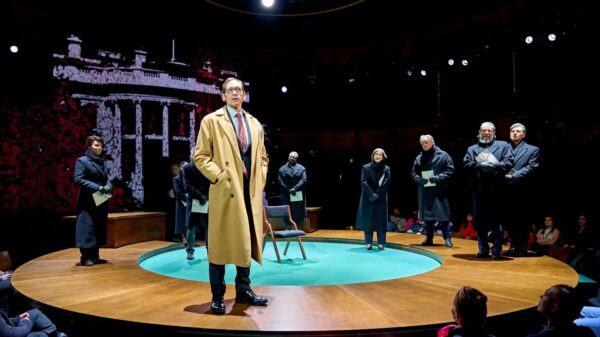
The staging of both plays further mirrors their modernisation. My Master Builder opens and ends with an imposing architectural design – a cathedral taking the role of one of Solness’s newest builds. Switching between this and a grand house at the Hamptons, it represents an explicit modernisation of the play from the start, as the architecture is reminiscent of modern builds. Similarly, The Lady from the Sea is set in a modern lake house. Here, the stage can be manipulated to represent the impressive back garden, its own swimming pool, and the lake itself. This modern reliance on the ambition of staging is integrated into the story itself and helps to drive the emotional narrative.
Why modernise at all?
The modernisation of productions is important in making plays more accessible to audiences unfamiliar with the original content. Both works aim to give a sense of current relevance to Ibsen’s pieces by translating the story into an easily recognisable modern equivalent. However, to keep the stories compelling to all audiences who are both familiar and unfamiliar with the work of Ibsen is seemingly an impossible task – by focusing too much on modernisation and star casting, one risks alienating fans of Ibsen’s original plays. At the same time, a production mirroring Ibsen’s intent can prove unappealing to audiences who believe this to be too difficult for the general public to access.