Staff Writer Holly Banwell deep dives into the background, fallout, and question of what happens next at the BBC amidst resignations and legal threats from the US President.
On 3 November, The Telegraph published an article titled ‘BBC’s Trump bias exposed in memo leak’, which contained a more than 8,000 word memo written by Michael Prescott. Prescott had been an independent adviser to the BBC’s Editorial Standards and Guidelines Board for three years, before leaving in June.
The memo raised concerns over the BBC’s impartiality, citing a specific BBC Panorama documentary, ‘Trump: A Second Chance’, where a clip of one of Trump’s rally speeches had been edited, to the effect that it appeared he was explicitly inciting the Capitol Hill Riots of January 2021. You can see the clip before and after editing here.
The following few days saw a tidal wave of responses from UK politicians including Kemi Badenoch, Ed Davey and Boris Johnson, as well as scorn from across the pond, with White House Press Secretary Karoline Leavitt branding the BBC “100% fake news“.
The BBC itself was slow in its response, which culminated on 10 November with the unprecedented resignation of both BBC director general Tim Davie and CEO of News Deborah Turness. Apparently unsatisfied with this already drastic move, Trump threatened to sue the BBC for $1bn (£760m) the following day, unless they issued a ‘full and fair retraction’ as well as an ‘apology’, by 14 November at 22:00 GMT. In response, the BBC issued an apology, with BBC chair Samir Shah writing to the White House personally, however refused to accept the defamation claims. ‘While the BBC sincerely regrets the manner in which the video clip was edited, we strongly disagree there is a basis for a defamation claim’ a BBC spokesperson said.
BBC’s history in the firing line
The BBC is no stranger to controversy and criticism. Since 2020, scandals surrounding high-profile BBC employees have threatened the institution’s reputation, from Huw Edwards’ suspension in 2023 for the purchase of child pornography from a sex offender, to Greg Wallace’s sacking earlier this year, after 45 claims of misconduct against him were upheld.
These individual scandals aren’t the only backlash the BBC has faced in recent years. In February this year, the BBC pulled its documentary ‘Gaza: How to Survive A Warzone’, after it was revealed that the father of the young narrator, Abdullah Al-Yazouri, was a Hamas official. The blunder resulted in the BBC receiving their first ever sanction from Ofcom, for what they termed a ‘serious breach’ of broadcasting rules.
Just a few months later, the BBC was heavily criticised for broadcasting Bob Vylan’s controversial Glastonbury set live. Vylan’s set, which featured the chant ‘Death, death to the IDF’, was in breach of the BBC’s editorial standards.
Michael Precott’s leaked memo addressed not only the Panorama editing error, but also alleged that the BBC’s Arabic coverage privileged pro-Hamas views. Prescott’s view that the BBC is institutionally biased is one that’s been debated for years in the public and political spheres, yet the BBC remains the most trusted and dominant source of news in the UK according to the Reuters Institute. Former-BBC journalist Lewis Goodall clapped back at claims that the BBC is left-biased in a recent interview with The News Agents. Goodall refuted the claim that all the “political pressure comes from one direction”, arguing that such pressure comes not just from outside, but from “within” the BBC, with figures like Robbie Gibb, and former-BBC correspondent David Grossman, his boss at the time, instigating from inside the institution.
Political responses
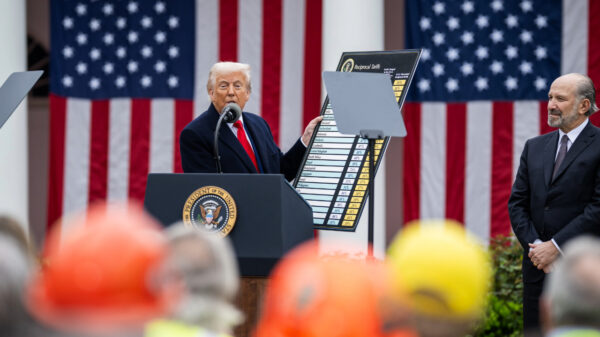
Some familiar faces have come out of the woodwork in response to the controversy, not least the US President himself, whose dealings with the media have always been fraught. Trump has filed lawsuits against countless institutions on his home turf, from The Wall Street Journal, to The New York Times just this September.
Trump’s response to the BBC is part of his ongoing rejection of and active attacks upon traditional media and journalists. His gloating response to Davie and Turness’ resignations just about sums it up:
“The TOP people in the BBC, including TIM DAVIE, the BOSS, are all quitting/FIRED, because they were caught “doctoring” my very good (PERFECT!) speech of January 6th… Thank you to The Telegraph for exposing these Corrupt “Journalists.” These are very dishonest people who tried to step on the scales of a Presidential Election. On top of everything else, they are from a Foreign Country, one that many consider our Number One Ally. What a terrible thing for Democracy!”
Trump on ‘X’
One might wonder why Trump is so keen to slander the BBC, but in recent years the corporation has risen in popularity in the States, landing it currently as the second most trusted news source for Americans.
On 10 November, Leader of the Liberal Democrats Ed Davey wrote a letter to Keir Starmer, Kemi Badenoch and Nigel Farage, addressing Trump’s involvement:
‘It should be extremely concerning to us all to see the President of the United States pressuring the BBC over its leadership and attacking its journalists as corrupt… It should not be up to foreign powers to dictate where the British people get their news from.’
Ed Davey in a letter to Starmer, Badenoch and Farage
In an article penned for The Guardian, published on the same day, Davey made a similar plea in favour of the BBC: ‘The BBC belongs to us all. We own it, we pay for it, and we treasure it. We cannot let it be destroyed by its enemies – whether that’s Trump, Farage, the Conservative party or anyone else.’
Badenoch’s stance was abundantly clear with a brash statement, “I do think heads should roll“, made to GB News. The Prime Minister has stood by the BBC—a spokesperson said that Number 10 did not believe that the BBC was either corrupt or institutionally biased.
‘Coup’ from inside the BBC?
As the week progressed, troubling stories started to come out from within the BBC hinting at a potential ‘coup’ that could have led to the resignations. David Yelland, former editor of The Sun and now presenter of a BBC podcast, told Radio 4’s Today that Davie and Turness were ‘systematically undermined’.
Culture and Media Editor Katie Razzall echoed Yelland’s assertion in an article for the BBC, where she wrote the following:
‘…as with any resignation, and certainly with two, I can’t help thinking there is more to this than meets the eye. And there is another story emerging about the functionality and make up of the BBC Board and its role in what has happened.’
Katie Razzall, BBC Culture and Media Editor, in an article for the BBC
The other ‘story emerging’ has chiefly to do with the BBC Board—you’ll recall that Michael Prescott was an independent adviser to the Board for three years. However, it’s another Board member who’s come under scrutiny off the back of the resignations: Sir Robbie Gibb, appointed to the Board in 2021 by then-Prime Minister Boris Johnson. Gibb’s links with the Conservative Party (having also served as Theresa May’s Director of Communications) as well as his friendship with Michael Precott, have sparked rumours that he ‘led the charge’ against Davie and Turness.
Given Gibb’s Tory affiliations and perceived involvement in this controversy, there have been calls for him to resign along with Davie and Turness, with Ed Davey suggesting that ‘the government should remove him from the board immediately’.
The future of the BBC
Facing internal turmoil, along with political attacks from the UK and US, all without two of their most influential and essential staff, it’s fair to say the BBC is looking the most fragile it has in years, perhaps ever. Various political parties and media sources are clearly vying to spin a narrative about the BBC after the events of last week.
This most recent controversy comes at a tender time for the Beeb, with the Royal Charter—the constitutional basis for the BBC’s public purposes and independence—coming up for review in December 2027. The BBC’s funding model will likely be called into question. Currently, the TV license fee accounts for two-thirds of the BBC’s annual revenue, which amounts to £174.50 per household per year for a standard colour TV license. And yes, this does mean that if Trump successfully sues the BBC, most of that $1bn will have come from the pockets of the British people.
The TV license fee has always been contested, but in the wake of last week’s events, many are calling for its abolition, with Boris Johnson stating in an interview with The Sun that he’ll ‘stop paying’ the fee, and The Daily Mail’s ‘Poll Of The Day’ on Monday the 10th reading, ‘Is it time to scrap BBC licence fee as corporation finds itself embroiled in ANOTHER scandal?’ 96% of 15,757 total voters said yes.
In summary, the BBC’s future as our national broadcaster seems precarious. Could one of the world’s most trusted news sources be seriously under threat?
A call to action for the British people – My personal thoughts
The dogpiling—from Tory leaders in the UK quick to slate the BBC, branding it ‘biased’, to Trump and White House officials writing slander on ‘X’ and ‘Truth Social’—has been relentless.
Whatever stance you take on the controversy, the level of outrage and political scrutiny on display has proved one thing: the BBC remains hugely influential. The aggressive eagerness to dismantle the BBC points to the fact that it is a massive threat to right-wingers like Farage and Trump. As Ed Davey neatly put it in his Guardian article, ‘If your power is built on conspiracy theories and distortions of the truth, the last thing you want is respected, independent journalists exposing that and holding you to account.’
No media source is perfect, and no media source can ever be entirely unbiased; the BBC certainly should come under criticism for bad mistakes like the Panorama edit and the Gaza documentary, and undoubtedly must continue to be heavily scrutinised and held to account in order to maintain its standards of independence and impartiality. But the resignation of two of the BBC’s most high-ranking staff feels like overkill—I can’t imagine a similarly proportional reaction if, say, The Sun or The Daily Mirror, made a shoddy edit.
The BBC is the property of the people: we pay for it, and it functions to serve us and act as our voice globally. Traditional institutional journalism is increasingly being sidelined in favour of social media as a source of news, allowing figures like Musk and Farage to fill the vast information space with propaganda.
We know that independent journalism is one of the pillars of democracy, a pillar that I believe remains strong in the UK, largely due to the BBC along with other prominent broadcasters. Trump has been demolishing that pillar in the US, and is now attempting to chip away at its foundations over here, alongside Farage and various right-wing groups. Now is the time to say “no, we won’t let that happen here.” I would argue that if there was ever a time for the British people to stand in solidarity beside the BBC, this would be it.
The BBC is the voice of democracy in the UK. We cannot let it be commandeered by populists and propagandists. We cannot let it be compromised by foreign powers.
The BBC is my voice. The BBC is your voice. What do we want to say?
To read more of our political analysis, click here.

Welcome to my profile, I'm Holly and I'm currently studying Literature at KCL. I'm interested in culture, social commentary and news - have a look at some of my articles below...