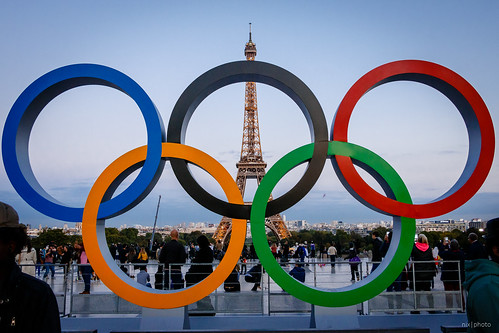
Sports Editor Sam Lord looks back to three far-right responses to the Olympics, claiming they have made it one of the more controversial games we’ve seen in recent history.
This article was first published in print on 16 September 2024.
The Olympic Games are no stranger to controversy. Every four years the world’s largest sporting event brings about a heavily scrutinised series of challenges and pressures on a host city. And despite the International Olympic Committee’s (IOC) best attempts, politics always seep itself into the attempted apolitical framing of the games. We’ve seen this throughout the history of the Olympics, as previously covered by Roar.
The issue remains that the Olympics is a globalised spectacle, with every detail broadcasted to an audience of billions. And the advent of social media has meant that the ‘greatest show on Earth’ has become the most scrutinised. However, this pressure is nothing new.
What is new, and has indeed made the Paris 2024 games unique to its predecessors, is the upset it has drawn from far-right observers. Again, politicised critique of the games is nothing new. What is new is the now global scale of this outrage. But most significantly, this outrage is being drawn up about literally nothing. I will consider three such instances here — singer Aya Nakamura, ‘The Last Supper’ controversy and boxer Imane Khelif.
Aya Nakamura
The first instance of controversy around the Opening Ceremony occurred months before it took place with the speculated selection of French-Malian Afrobeats singer Aya Nakamura.
Currently, Nakamura is the most-streamed Francophone musician in the world, so her inclusion was highly suspected. This resulted in backlash, especially as it was rumoured she may be performing an Edith Piaf song. One poll even implied that the large majority (63%) of French people did not want Nakamura to perform during the Olympics.
Nakamura became the victim of an online hate campaign, in which misinformation was spread about her nationality. The group Les Natifs in one protest displayed a banner saying: “There’s no way, Aya. This is Paris, not a Bamako market”. Whilst Nakamura was born in the Malian capital of Bamako, she emigrated and received French citizenship as a child and grew up in the Parisian suburb town of Aulnay-sous-Bois.

In the end, Nakamura performed a selection of her songs in front of the Institut de France alongside the French Republican Guard.
The claims of Nakamura reducing the ‘Frenchness’ of the ceremony seem ironic, considering Celine Dion was given her spot as the epic finish to the ceremony. Dion is Canadian, and unlike Nakamura doesn’t have French citizenship, yet her performance deservedly received unanimous praise, whereas Nakamura’s inclusion still left a sour taste in the mouths of many on the far-right.
The ‘Last Supper’
The largest controversy to stem from the Opening Ceremony came from many right-wing, particularly Christian, viewers as the performance on the Passerelle Debilly footbridge appeared to show a ‘mockery’ of the Leonardo Da Vinci painting of The Last Supper. The performance featured multiple LGBTQ+ icons, including drag artists and even a near-naked blue man.
Initially, this sounds confusing to hear. The da Vinci painting has little to no connection with Paris or France, so it would be an odd inclusion in a celebration of French and Parisian culture. It’s not even as if the painting is hanging in the Louvre; it resides in Milan. Paris may be the City of Cathedrals, but France remains a deeply secular state, which was reflected in the Ceremony. No Christian or other religious imagery was displayed, except for the ringing of the bells of Notre Dame, the first since the building was engulfed by flames five years ago.
Indeed, it was not the intention at all by the organisers to mimic the ‘Last Supper’ painting. Instead, as the artistic director of the Games Thomas Jolly explained, the performance was a re-enactment of a painting depicting Greek gods partaking in the banquet at Mount Olympus, called Le Festin des Dieux, which is displayed in Dijon. This, of course, makes much more logical sense, considering the Greek origins of the Olympic Games.
Nevertheless, the organisers did apologise for the misunderstanding. Yet, it appears it did little to fan the flames or settle the confusion. The Vatican, in a notably late response, issued a statement saying they were “saddened by certain scenes at the opening ceremony“. Far-right figures such as Andrew Tate even staged a protest outside the French embassy in Romania and called for a boycott of the Paris Olympics.
Global outrage and a weak response to quell misinformation make sure the Paris Opening Ceremony will go down in history as one of the most controversial.
Imane Khelif
The most egregious example surrounded Algerian women’s boxer Imane Khelif. On 1 August, Khelif drew controversy with her fight against Italian boxer Angela Carini, who abandoned the fight after 46 seconds. Carini was heard after she called off the fight saying repeatedly, “It’s not right“. The backlash from this fight was massive and instantaneous, with waves of right-wing commentators falsely claiming Khelif was a transgender woman.
Any second thought about the situation should’ve settled the matter immediately. Algeria is a country in which LGBTQ+ rights are non-existent and women’s rights are still repressed. In fact, Khelif spoke up about the difficulty of becoming a female boxer to represent her country.
The Khelif situation is also the most adamant example of counters to far-right misinformation, by both sporting bodies as well as the general public. The IOC defended Khelif in many press conferences, putting to rest any debates about her sex. They even went as far as to call for a new boxing federation, in light of the controversy surrounding unclear eligibility tests and the 2023 suspension of Khelif and fellow female boxer Lin Yu-ting. What’s more, there was a counter-wave of support for Khelif on social media, much larger than the wave of hate towards the boxer.
Both Khelif and Yu-ting won gold medals. Carini apologised to Khelif, who has now brought forward a cyber-bullying lawsuit, which has even reportedly named figures such as J.K. Rowling and Elon Musk.
As the most countered piece of misinformation from the games, it remains the most successful in exposing the nasty habit of the far-right’s usage of misinformation.
In a Wider Context
Of course, the politicisation of each Olympics is unique to its contemporary geopolitical climate. Berlin 1934, the rise of fascism and the Nazi Party; Tokyo 2020 and the Covid Pandemic; and now, Paris 2024 and the prevalence of far-right misinformation campaigns.
2024 is the biggest election year in history, with elections being held in more than 60 countries of a combined 4.2 billion people. As such, political tensions are high and misinformation campaigns have become more frequent.
We’ve seen that the trend of misinformation from far-right groups has real-world consequences. In the UK, recent far-right riots and direct violent attacks on Muslim and ethnic minority targets began after misinformation spread across social media that the perpetrator of a stabbing of three young girls in Southport, Merseyside, was a Muslim illegal migrant.
Likewise, misinformation has become a modern staple for right-wing populist candidates. US presidential candidate Donald Trump has been accused by fact-checkers, and his political opponents, of spreading false information in almost every public appearance. This includes a ‘blatant’ misidentification of Khelif and Yu-ting to push for further anti-transgender policy in US schools.
The fake-fueled outrage at the 2024 Olympics is ultimately a litmus test for how those on the far-right intend to fabricate information to influence their agendas. The whole situation surrounding the Paris games has highlighted how ridiculous some of this misinformation can be—but also how easy it is for it to spread across the internet and how easily it can be used to advocate for political policy.