‘The rain falls down harder on you when you try to avoid it’
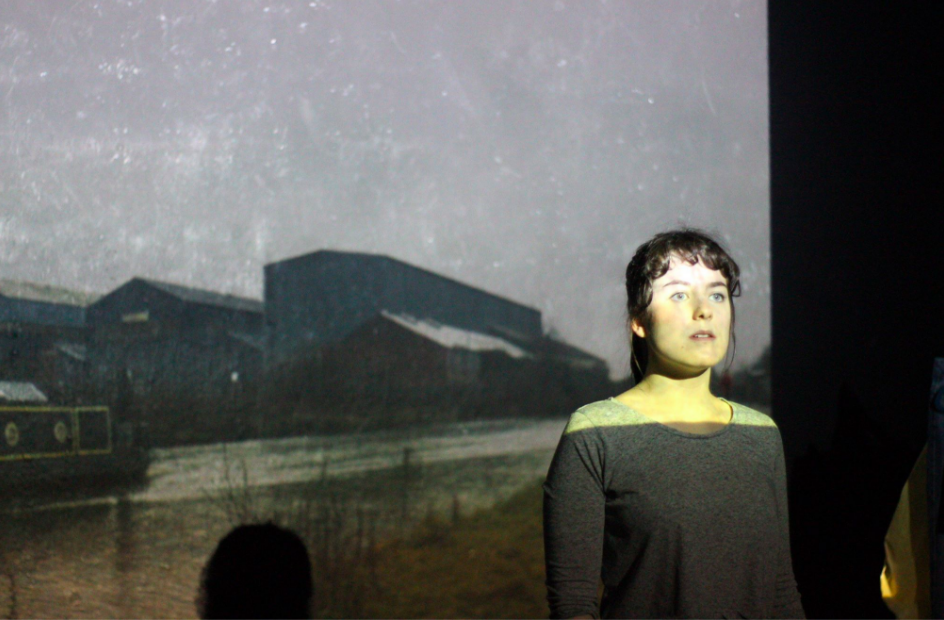
Thomas Froy’s The Sea exposes isolation in between London’s multitude of communities. Following the character of A (Sarah Dean) and her eventual meeting with B (Rebecca Hendri), the play transitions between extended soliloquies and duologues. Loneliness and isolation haunt the character of A, rendered in regular projections of bleak imagery on the back-wall of the set. The vast expanse of a gentrified Stratford, greyscale streets and an overcast canal-side view following a single runner are few of the clips that segment the production, providing a visual crutch to the near-oxymoronic concept of a ‘lonely London’.
Sarah Dean performs her role well. The spontaneity of a near-stream-of-consciousness is brought out believably due to her breath control and flitting intention of focus. At one point, A recalls a conversation with a friend, constructing the space physically and drawing the audience into her lonely world of over-reflection and analysis. This simulation of space is important alongside a fairly minimal set. A clothing rack is incorporated into the narrative as A changes her outfit frequently before the audience, signalling a new activity or event. The clothing rack continually reminds the audience that the entirety of the play focuses specifically on A’s space in contrast with the communal spaces of London.
The more conceptual focus on the aspirations of Londoners occasionally muddies any naturalistic self-dialogue. In one particular scene, A attempts to keep up with a faster-paced running group, eventually ‘giving up’ and falling to the floor in rasps of breath. The symbolism here of an impossibly fast-paced city effectively running away from the keen Londoner is obvious, but is presented to the detriment of emotional investment the character. She appears, in places, like a caricature of heightened emotion.
In a staggeringly well-conceived and executed scene concluding Act One, A’s attempts to connect with her London are brought to dramatic fruition. The second character of B, played equally as well by Rebecca Hendri, enters on a public bus. Synchronised, tightly- choreographed physicalisation, once again, constructs the space of a moving vehicle, a London street and the entrance to B’s apartment, as A follows the character home. In an intensely written and delivered monologue, A then articulates the overwhelming gravity of a London wherein sonder exists down every alleyway. ‘Shocking flashes of red’ give way to ‘a warm, cold sea’ as the character calms and retreats into her less turbulent inner world.
Act Two sees A with a new phone. This ‘new connection’ allows her to connect with the London she feels so disenfranchised from in Act One. Focusing on frustrating attempts to meet up using technology, the second act is given a jarring sense of dislocation from the first. This vague lack of alignment looms over the act tastefully, heightened by differences between the two characters. Towards the end of the act, A uncomfortably, yet poetically, recounts the rainfall at Hackney Marshes to a stoic B. At times, specifically at latter points during the play, the dialogue seems to be an obvious and crude imitation of social interaction, but this works to its advantage.
Due to the small cast size, the audience is given an in-depth insight into the anxieties of a single character, assisted by the counterpoint of B. Well-paced and precisely blocked, Froy’s direction cleverly opens the space for both actors to engage with their respective characters.
In a play that seeks welcoming spaces, the believably-constructed spaces of A’s mind become the central focus.
About the author