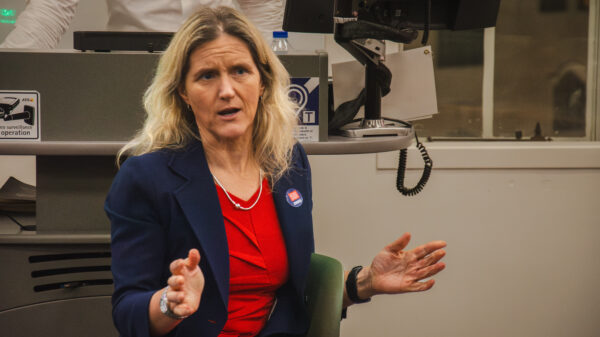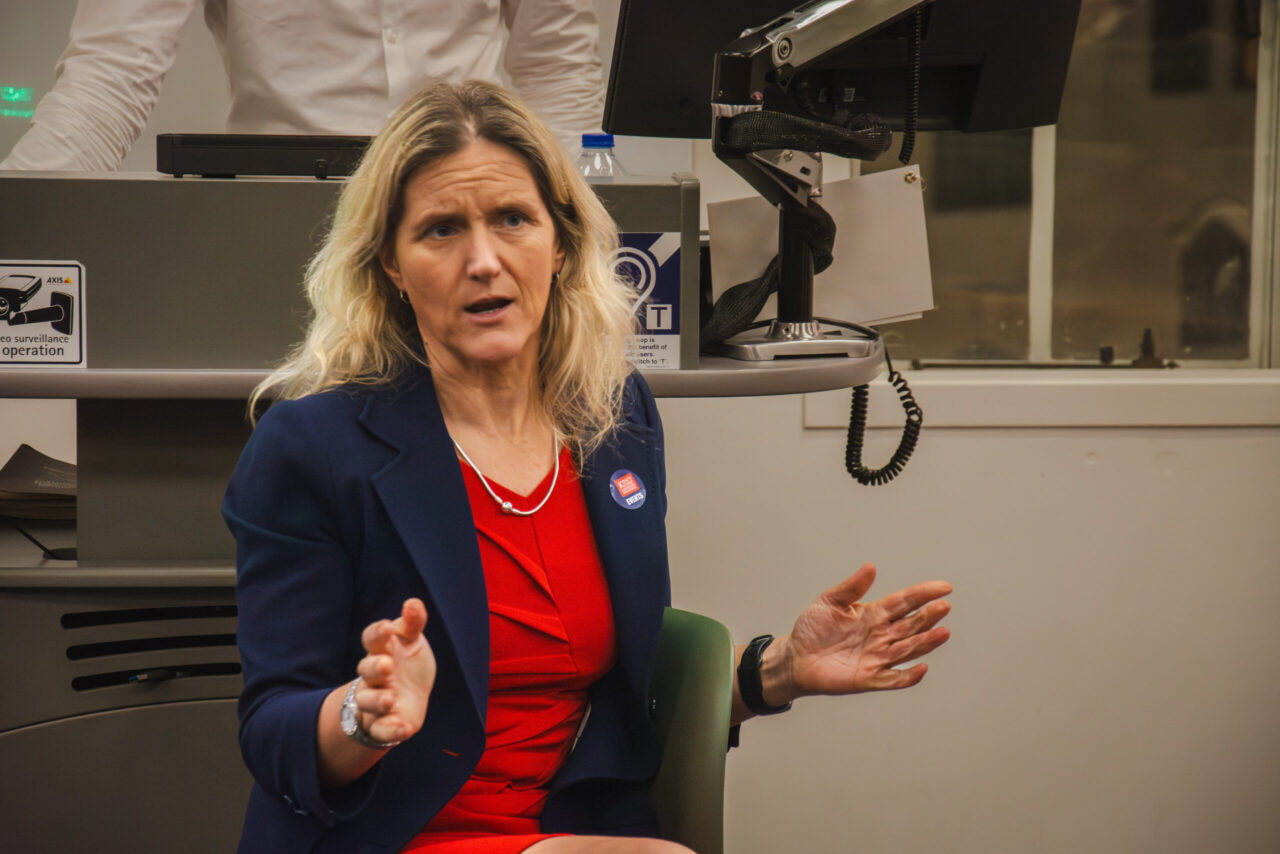
Staff Writer and Broadcaster, Penelope Spencer-Simpson, attends and examines the King’s College London Politics Society ‘In Conversation’ with Kim Leadbeater, the MP for Spen Valley.
When the public think of MPs, they often assume they are serious, humourless and stoic. The MP for Spen Valley could not have been further from the stereotype.
From the moment audience members stepped into the lecture theatre, Leadbeater greeted each audience member with questions and welcoming remarks. Specifically elated at the attendance of fellow Northerners in the crowd.
Although it definitely lightened the energy of the room, it does not compare with the sheer sincerity shared in Kim’s lament reflections on her late sister, and the previous MP for the then Batley and Spen constituency, Jo Cox. The MP who was murdered in her constituency a decade ago.
Unlike her sister, Kim did not know what she wanted to do at a young age, but explained she was passionate for sports, health and well-being. Though it was after the passing of Jo, she involved herself ion British politics. The creation of the Joe Cox Foundation seemingly not only perpetuated her career in politics, but clarified the issues she advocates for now as a parliamentarian.
The advocate for the Terminally Ill Adults (End of Life) Bill offered her sincerities for the stress this Bill has caused her peers. However, she believed politicians need to understand the human experiences that into reaching this ultimatum. Leadbeater shared this concern with the audience as a reminder that it is both a human and legal discussion. It was clear that Leadbeater offered her sincerities to terminally ill individuals who are ultimately at the heart of this bill. Which, this emotive side of political thinking is too often missed and ignored.
However, despite these sincerities, she expresses her frustration and the challenges of the parliamentary ping-pong of the Bill between the House of Commons and the House of Lords.

This frustration was clear when Roar questioned Leadbeater on the divisions and disillusionment the Bill created, especially when addressing these complexities to her constituents and the public.
“One of the biggest challenges for me at the moment is the vast majority of the public think the bill has passed. So wherever I go, people come up to me and say, thank you for getting me assisted dying locally.”
The inconsistencies of the Bill, and much more so the disbelief around the bill nationally, still clearly confuse constituents. Perhaps Leadbeater’s concerns over the concept of an unelected chamber are the reason Leadbeater remains frustrated at the technicalities of the Bill.
Interestingly, Leadbeater did not hesitate to criticise the plethora of media coverage around Assisted Dying. She argues it is the narrative that pushes aggressive politics and clickbait for algorithms that blatantly ignore the human stories and influences behind the Bill. Arguably, her humanist approach to politics is refreshing and offers something different to the constant verbal sparring we often see from the House.
“I just don’t think it’s healthy and I don’t think, and I don’t think the public like it either. So I think there’s a lot that can be done to improve trust in politics, and a lot of that starts with people in politics themselves, it then goes out to the media, and it then goes down to individual responsibility.”
However, the media’s inability to replicate this more to the wider public supports her views on the ban of social media for under-16s. Unsurprisingly, Leadbeater told the audience she agrees with Labour’s call for a consultation on the ban. Despite this comment of support, she opted a semi-formal poll to those in the room to express their concerns with the ban. Most students unanimously voted in favour of keeping social media the way it is.

Jokingly, Leadbeater argues she would support a ban for under-30s from social media as a way to keep people connected and not swept into the artificial reality she refers to. Although practically, we live in a digital world and democracy, removing social media from people at the current voting age would do more harm than good to our current democratic process. However, it is understandable to want to reverse the addictions our generation now has to screens.
“I think I probably would support that because I do not think a five-year-old, six-year-old, 10-year-old, 12-year-old needs social media in their life. I am much more reticent about the 13 to 16-year-old because of some issues that I’ve mentioned earlier.”
With these screens, Leadbeater shared her concerns as woman politics. Amidst the rise of the “manosphere”, it was refreshing, yet unsurprising, that she expressed the concerns that women constantly face and do face in politics. Upon reflection on the MP’s late sister, Jo Cox, it is important to take away that political and female violence can often be intertwined, even if it is not physical.
It can be inferred to stem from Leadbeater’s hesitation on the use of social media, as she often referred to the platform as a powerhouse of sparking these sexist comments online. In reference to July 2025, when the Chancellor of Exchequer, Rachel Reeves, was seen “too emotional” during Prime Minister’s Questions (PMQs), became a misogynistic hellfire on the behaviour of women in the politics.
Although Leadbeater personally reflects that ‘We’ve come a long way’, with female politicians, it is significant to highlight that only 40% of MPs identify as women, still disproportionate to the 50% of women that live in the UK. Even though we might have come a long way in terms of women now active on the front bench, and agents in politics generally. Yet, misogyny still remains rife and a constant battle for female parliamentarians across the political spectrum.
Kim Leadbeater’s visit offers students insight into someone who was fundamentally disinterested in politics to someone who spotlights the political stage. As a female, northern MP with lived-experience, she is someone who British politics needs to utilise in policy making.