Culture Editor and Staff Writer Maryam Ahmed reflects on ideas of urban life from Zadie Smith’s recent Cities Imaginaries discussion.
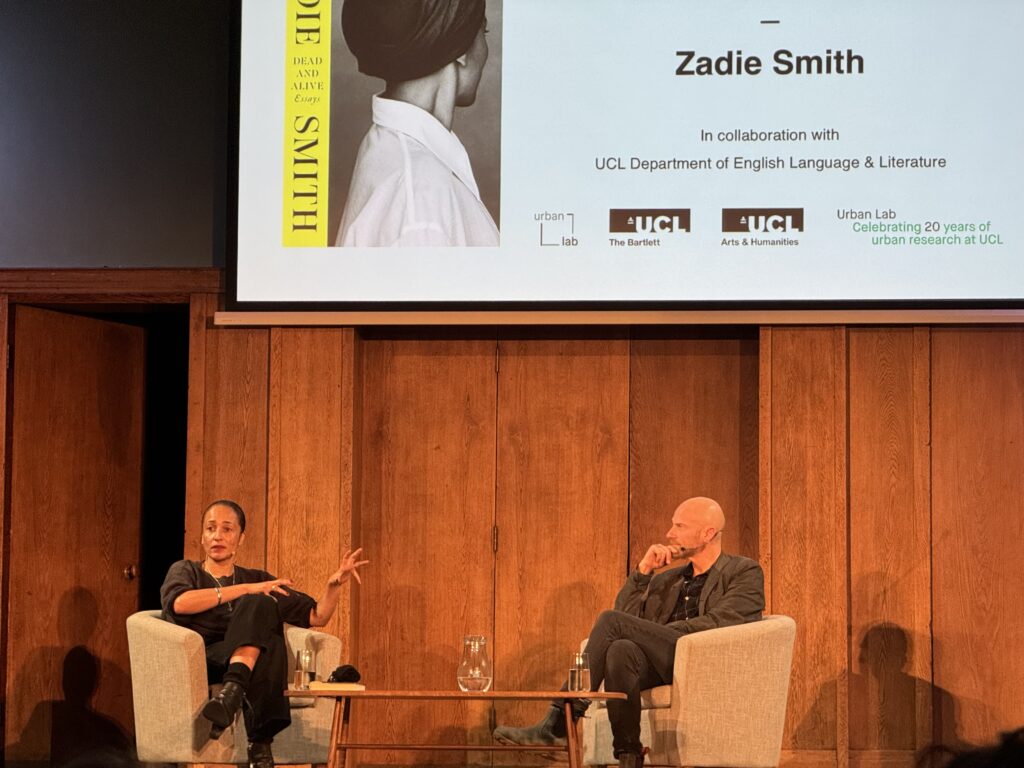
Mid-November and the sky is one week from sublating into a blank sheet. For now it’s a clear, tranquil, all-encompassing indigo, creeping earlier into the day like an afternoon catnap. In memory, you could almost fool yourself into remembering stars winking from between sparsely frosted clouds. On a technicality that has allowed me to sheepishly claim tickets, I’m joining an old friend at a discussion event held by the UCL English Department with Zadie Smith, the author of such familiar titles as White Teeth and N/W. Tonight’s occasion is the annual Cities Imaginaries lecture held by the UCL Urban Laboratory.
Her collection “Dead or Alive” hot off the press, Smith is this year’s guest lecturer for the urban-life themed discussion. She is here to read her essay “Under the Banner of New York“. The work interweaves themes of culture, politics, art, and identity as they express themselves through the “unit” of the city. The City: a thing alive with architecture and routine, “defended against the country” as the binding identity of its population.
The moment she enters the room is strange for me. A melange of students and staff– knitted patterns, hiking boots and artfully clashing prints– converges in eager applause. It is the noise of precocious bookworms training into academic civility. Personally, I have enjoyed several dialogues with Smith; now a joke over coffee, now a tense but good-natured debate. She lights the match in her writing, and I fan the flame in thoughtful response. It’s disorienting to see in the flesh someone with whom you have a para-social relation. Smith captures this with exacting precision near the end of the night, referencing her own experience as a reader:
“I’ve been in your mind, you’ve been in my kitchen.”
It is this I have come to expect of Smith: a sharp, fast wit, relaying complexity with striking and deftly unlabored prose.
The banner: cities as “organising social principles”
“Under the Banner of New York” is no departure from Smith’s easy, electric style. She paints NYC as she inhabited it: interconnected beyond words despite the relentless pace for which its folk are criticised. Habit and hurry become unspoken forms of solidarity. To illustrate this, she recounts one morning when a young mother’s baby stroller collapses, and Smith alongside a group of widely different strangers– a “cross-section of the city” – immediately band together with minimal contact and maximal efficiency to fix it. Afterwards, the mother’s grateful “thank you” is functionally a “propulsive force, sending each of us scurrying back to our routines, heading uptown or down, into classes or offices or gyms, unconnected to this mother and child or to one another.” This, Smith deems the “elasticity” of cities: that they bend, accommodate, and still keep with the rhythm of the everyday.
In contrast, my early understandings of community were imbued with extended goodwill, involvement and saccharine warmth. Imagining the big, cold city as an “organising social principle” entirely reframes London to me (although we differ greatly from New York). Those unsmiling strangers on the tube look particularly dead-eyed on days when our empathy has reached the end of its line. Yet, retrospectively, I have been on all ends– giving, receiving, and observing– of those small, myriad unsexy kindnesses that make a city an “elastic” structure: well-oiled, waterproof, resilient.
This is not to say, however, that the city is an infallible social system. Indeed, it grows ever more fragile amid our contemporary, meticulously mediated reality.
The limits of elasticity?
Ours is an age that future generations will undoubtedly look back on as a hotpot of atomisation, hyper-individualism, volatility, and gilded economies. Embers of progressive liberalism have calcified into a political binary more divided by semantics than by substance. We vote for populists and far right grifters. Our algorithms congratulate us when they win. The erosion of physical third spaces narrows the way out further and further. How long before the rubber band snaps under the weight of a city lived without community?
Perhaps, Smith posits in response to this question, there is hope in Mamdani’s New York. A coalition formation requires asking “one big question”; one unpretentious banner under which to draw a cacophony of people. For New York, she notes, the multi-billion dollar question was ultimately
“Can you afford your rent?”
This is an all too familiar story for the young Londoner. The basics are priced like privileges. The lunch that cost me £7 at The Vault in my first year now costs closer to £10. For Smith, today’s London is a city far removed from that of her youth. Its former ease now clusters around the wealthy, sun-washed white brick of places like bohemian-bourgeoius Notting Hill. Her children attend schools which cannot afford to provide instruments for students to learn, a matter of basic amenity in her day.
Still, people are as in need of change as they are disillusioned with our institutions. How do you rally a city like that? In fact, the unit you seek to organise is often “not the kind of proletariat you wanted”, as Smith describes the socialist activists preaching to an indifferent working class in her childhood neighbourhood. So, what is it about Mamdani’s question that achieved what no left-wing candidate has been able to in a decade?
Considering the mosaic of urban life
The devil is in the details. The answer to consolidating urban community is not in turning individual interpretations of the city into a monadic identity. Indeed, it is not possible for any banner to achieve this. During the Q&A section, an audience member shares that, having newly moved to London, it was Zadie Smith’s pen that guided her tour of the city. “Well then,” Smith jokes, “I’m sorry to say you’ve exclusively toured North West London”. The joy of this response does not lie only in its witticism, but in its subtextual instruction: go find your own version of the city. Just so, she emphasises, within each one of us is a “Tolstoyan epic” of history and interpretation that we carry into town. Time, identity and individual narration lay their unavoidable judgments at our door and force us to reckon with their verdict. Elasticity cannot require us to push aside these individual experiences. Instead, it weaves together the nodes at which our stories overlap at the critical moment.

This city, the city of my dreams and of my deepest despair. I’ve lived a century in the arms of its cornered streets, the ghost of a child twirling with arms wrapped around its yellow-lit pillars or in the downward spiral of its lemon leaves shed in the autumn’s seduction. I can only imagine the asterisk of lives I might live and still return here to find her. But she is not mine alone. A mosaic of politics and art and time and youth upheld by the atoms of its inhabitants, it is our rubber band to stretch or to snap. We may find thought from a place of curiosity and care. Or, we may cling to personal ideals of the city like childhood trinkets we have not yet learned to share. It is my hope, against the odds, that we choose wisely.