Staff writer Kaveh Kordestani explores and reflects upon the TEDxKCL 2025 event.
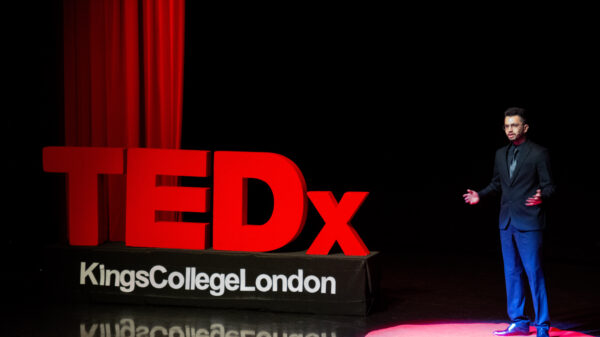
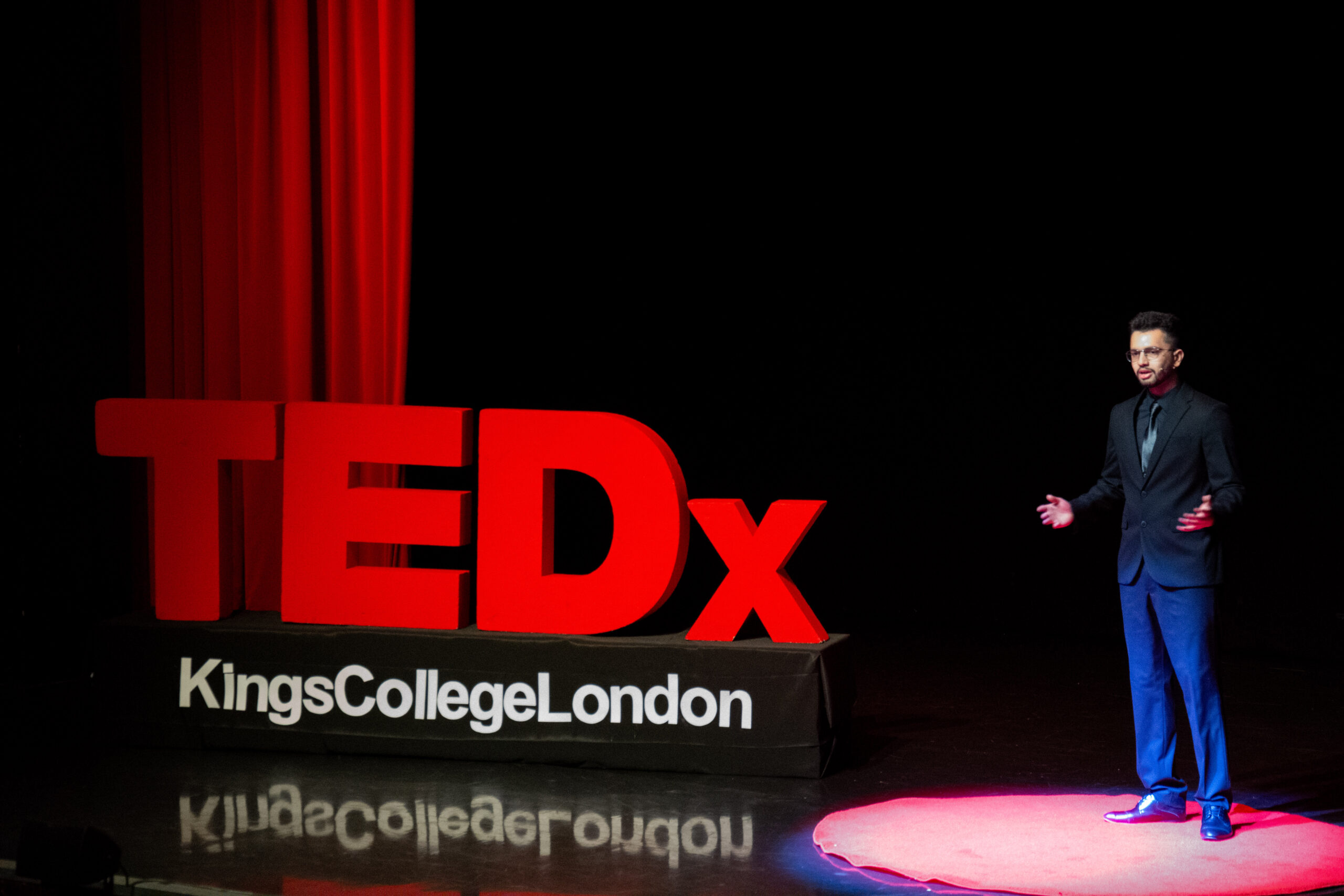
The Greenwood Theatre is a surprisingly fitting venue for a TEDx event, and that’s not just because it provides plug sockets for my laptop. When the lights go off, the famous TED design becomes apparent – those big red letters, spotlighted circle and dark backdrop.
TEDxKingsCollegeLondon is an independent event, however, organised and facilitated completely by King’s students. It has little intervention from TED, other than the organisation’s strict licensing conditions (and apparently a prohibition from using apostrophes).
But don’t let that ‘student-run’ tag fool you, for whilst this event certainly does have those amateur kinks you would expect, its organisers expect nothing less than a professional experience for all those attending and speaking.
I arrived early and watched the many clearly dedicated volunteers fussing over the exact positioning of the TEDx logo for over thirty minutes. Whilst perfectionism might be a bit far, it is clear that this has been a very deeply thought-out event, from the pianist and singer in the intermissions to the bespoke ‘trophies’ awarded to each speaker.
You would hope so, at least, for an event that has had a slightly troubled past here at King’s. Last year’s event foundered completely, so for many volunteers this was their first time participating in such a conference. Perhaps it made sense then that this year’s theme for the conference was ‘permission to change’.
Whilst the link to this theme felt slightly tenuous at times, that was made up for by the quality of the nine lectures we heard. The organisers say that over 100 people applied to speak, and the breadth of the speakers made it clear that this was a highly curated selection.
The lectures
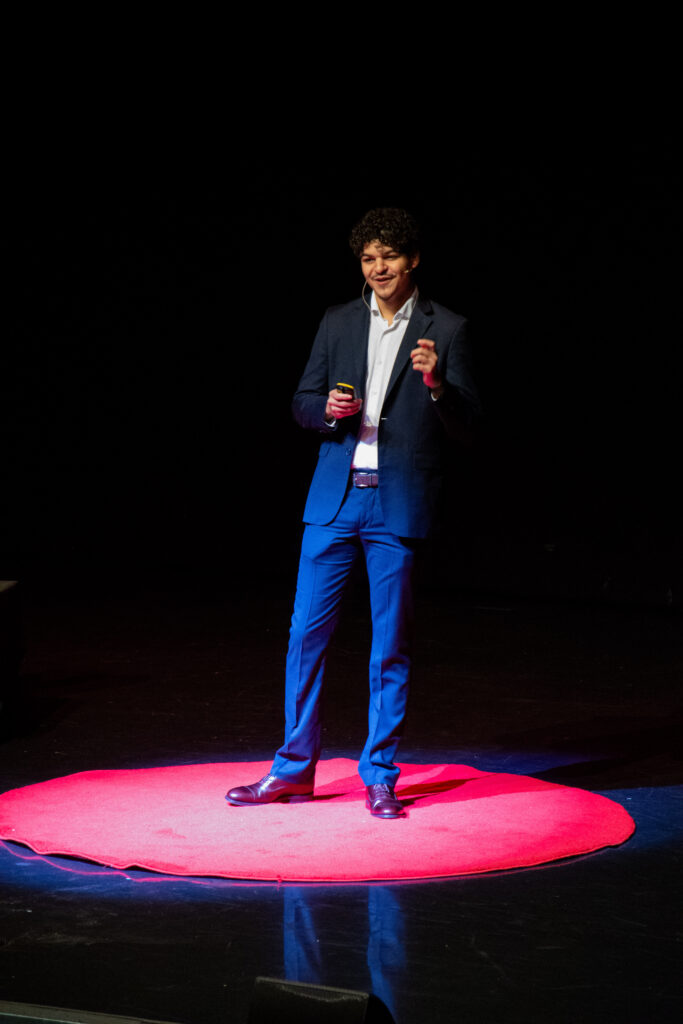
We opened to Marcos de Souza, a KCL alumnus from Brazil with unconventional dreams but large aspirations, which he certainly fulfilled, founding his own biotech startup. You’d ostensibly hope for at least one KCL staffer, and here it was, Dr Roberto Fumagalli, a PPE lecturer. Similarly unconventional, his academic career stemmed from a bet with his parents – despite his prestigious economics degree from Bocconi, he decided to study a master’s in philosophy at the LSE, with his parents’ funding determined by his grades.
Julia Jones, a self-described ‘habit-hacker’, was next. Many of us struggle with eating healthily, especially when doing so seems to be expensive both for our pockets and for our time. You would assume that – in a world with seemingly limitless technological innovation – that this too could be tackled by some amazing AI agent, or right?
Wrong, says Jones: even with huge growth in the wellness sector we have, on average, also seen huge growth for our waistbands. Technology seems to have failed in this regard; her solution is going back to humans. Through a series of experiments, she found that just the ‘light-touch’ of a human is enough to significantly improve retention of healthy habits. An app can’t really hold us accountable, can it?

Nik Gowing might be a familiar name to older audiences – he was the lead presenter for BBC World News from 1996–2014. After adjusting himself and looking around coyly, he bolted straight into a lecture about how ‘the stability we take for granted is unravelling’. An unexpected shift from the optimistic speeches leading up to it, Gowing presented a world in which nothing is guaranteed – where stability is no longer something we can take for granted.
It was difficult not to be taken aback by his remarkably fast performance: if we did not think the ‘unthinkable and unpalatable’, he argued, then there is a real danger to the world – and we are already suffering the effects, as with the Covid-19 pandemic. We need a ‘National Stability Strategy’, not a security one.
Yet more talks came: Ramit Mehta stressed the importance of the ever-disappearing ‘third spaces’ (think libraries, parks and social clubs) for tackling our loneliness epidemic, especially in light of the misuse of AI chatbots to talk to machine-generated echo chambers masquerading as ‘friends’.
Dr Khurram Sadiq offered a poignant yet medical-led analysis of the often poorly-diagnosed mental condition ‘AuDHD’, which shares elements of both autism and ADHD. Many forget that both conditions are still relatively new to many medical professionals (ADHD was only officially recognised in the UK in 2000) and that until 2013, they were considered mutually exclusive. Sadiq has been a campaigner for its recognition: many fall through the gaps because they do not present ‘enough’ conditions of either condition to be diagnosed, and thus are not given support by any of the respective services. The term remains non-clinical.
It was certainly interesting to see a current student on stage. Ananyaa Gupta presented on the social status of Multicultural London English (MLE), a hybrid sociolect of many different origins, ranging from Caribbean English to Cockney. Inevitably, with its tag as a ‘working-class’ dialect, it is deeply divisive, especially for speakers of Received Pronunciation (aka BBC English, King’s English, etc.), who make up as little as 3% of the population. Many MLE speakers are discriminated against for their accent, according to Gupta.
We ended on a sobering talk from Tiffany Luxford, who, after what was just a holiday ‘diet’, was diagnosed with anorexia in her youth. Many think that anorexia is an easily curable disorder – in reality, Luxford said that the reason it is so difficult to recover is that it gives “some sort of control, or at least an illusion of it”. After remaining sectioned on her eighteenth birthday, she later recovered. Her only regret? “Not starting recovery sooner”.

Behind the scenes
For an event that has been run at KCL since 2015, you would assume that there were considerable foundations in place for this year’s conference. This was not the case. According to Hasan Nasir, the conference president: ‘the majority of my focus was on making sure that everything we do is recorded in a way that, for the following years, they [the organisers] don’t have to do anything that we had to do, because we didn’t have those guidelines’. This isn’t Hasan’s first TEDx: he also organised one at his high school. Unfortunately, due to time limitations, the talks only went ahead after he had graduated; he was only able to watch the conference remotely.
One remarkable fact is that the organisers were not allowed to do any work until they were granted their TEDx licence in September. This meant, in Hasan’s words, they had to ‘fight’ for a slot at the Greenwood Theatre. “It was just chaotic. We had to fight a lot. It took us three weeks to get this auditorium”. The letters for the sign were cut out by hand, and the merchandise was procured from Pakistan. The entire operation was funded purely by ticket costs.
Unsurprisingly, managing people was one of the most difficult jobs. The conference’s vice-president, Angelica Jain, stressed all the different sub-committees in the TEDx society: “There’s a speaker team, internal relations, external relations. There’s a lot that goes into it”. She further stressed, “It’s a lot of hours, a lot of hours for each team, each person.”
It’s interesting to see what makes people want to organise an event of this scale. For Hasan, it’s an “event I’ve been looking forward to for three years”. For Angelica, participating in a TEDx at her school made her “feel like I was a completely different person”; since then, she said she has been taking every single opportunity that pushes me out of my comfort zone.
It’s clear that this conference was a labour of love, from the camera operators and photographers to the stagehands and presenters on stage. According to Angelica, “if one thing goes wrong, it kind of affects everything”. Minus some screen issues, this conference seems to have gone perfectly. Even if the organisers are done, that doesn’t mean they aren’t preparing the next series of lectures: “Hopefully, the conference gets better every single year”, said Hasan, “I think it was all worth it. It was wonderful. The event was amazing”.
The full series of lectures will be uploaded to the TEDx website and YouTube channel at a later date.

Staff Writer for Roar News