An open letter has accused King’s College London of pushing ahead with a controversial new assessment system that “devalues” degrees, based on documents the university released in August.
Transforming Assessment for Students at King’s (TASK) was unveiled last year as part of a push to “diversify” the university’s module assessment structure after it claimed that students were “not satisfied” with the current assessment system.
As part of the TASK changes, the university is seeking to “reduce the volume” of assessment and the “complexity” of choice in optional modules, claiming that the current number of modules available to students is creating issues for joint-up assessment of programmes.
Coursework word limits will be significantly reduced. For example, for a 15-credit module made up of two non-examined essays, each essay would be capped to 1300 words, a 35 percent decrease from the 2000 words previously allowed. On another 15-credit module, an essay that made up 100% of the mark would now be capped at 2500 words, whereas previously this would be 3000.
What is Changing?
Other than the reduction in optional modules and the ‘tariff’ changes, other changes include:
- A complete phasing out of exam-only assessed modules
- Restricting assessments to no more than 20% of teaching hours
- More detailed development of group-based assignments to reduce student dissatisfaction
- More “future-focused” assessments to “equip students for life beyond university”
- Integrating AI both into the development of assessments and their responses and promoting “AI literacy”
- Reducing the maximum length of certain audio-visual assignments
Open Letter
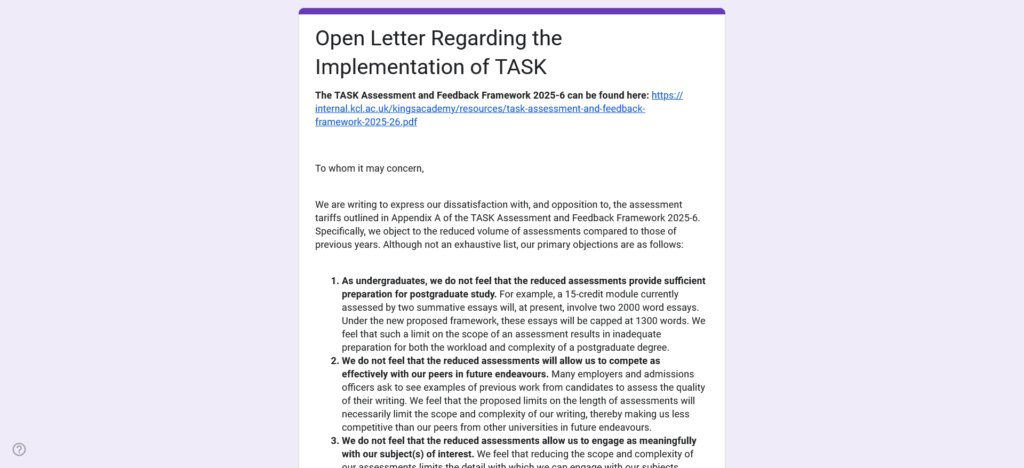
It is these ‘reduced assessments’ that have been particularly controversial. This week, an open letter has been launched by King’s students calling for “further consideration” to be paid to planned changes:
“As undergraduates, we do not feel that the reduced assessments provide sufficient preparation for postgraduate study… reduced assessments will [not] allow us to compete as effectively with our peers in future endeavours.”
Open Letter
The open letter argues that these changes will actually increase stress and thus worsen student satisfaction, and will not allow students to “meaningfully” engage with their courses.
The letter’s writers, second-year PPE students Michael O’Shaughnessy and Isabella Pierucci, told Roar they only discovered the raft of changes through the complaints of their lecturers – not from King’s directly:
“It’s a very obscure policy; no one knew about it,” said Isabella.
“We’re told this is based on feedback from students. We’re told this is industry best practice … and although every student we’ve spoken to is quite vocally against the implementation of this, they didn’t know it was happening”, according to Michael.
“…although every student we’ve spoken to is quite vocally against the implementation of this, they didn’t know it was happening.”
“What we’ve heard is that this is supposedly to try and boost student satisfaction levels at King’s, because some students have complained about the volume of assessments. But what the complaint seems to be is that assessments tend to be set around the same time – so often times you’ll be swamped with four or five assessments at once – not the length those assessments actually are,” he continued.
Student satisfaction is a recurring theme for the changes. Some think that King’s may be attaching to much weight to these results from the National Student Survey.
“I think it’s just a misinterpretation of student concerns, and their solution is just cutting down tariffs [word limits] where these efforts should probably be re-directed towards others,” said Isabella.
Whilst these limits are “recommended maximums”, it seems that many module conveners feel they are being strong-armed into accepting the limits. Michael said, “What we’ve heard from department heads that we’ve spoken to is that they really don’t have that much leeway in these things.”
That does not mean conveners are not trying to get around the new changes: he’s been told that a convener is “going to try and game the system in a way so that introductions and conclusions get cut out of essays … I think student satisfaction goes down when you’re handing in an essay without an introduction or conclusion. It’s an incomplete piece of work”.
Low assessment satisfaction
This year’s National Student Survey revealed that King’s had the fifth-to-worst assessment satisfaction of any of the 24 Russell Group universities. 76.3 percent of students said they felt assessments had allowed them to demonstrate what they had learnt; the UK average was 84 percent.
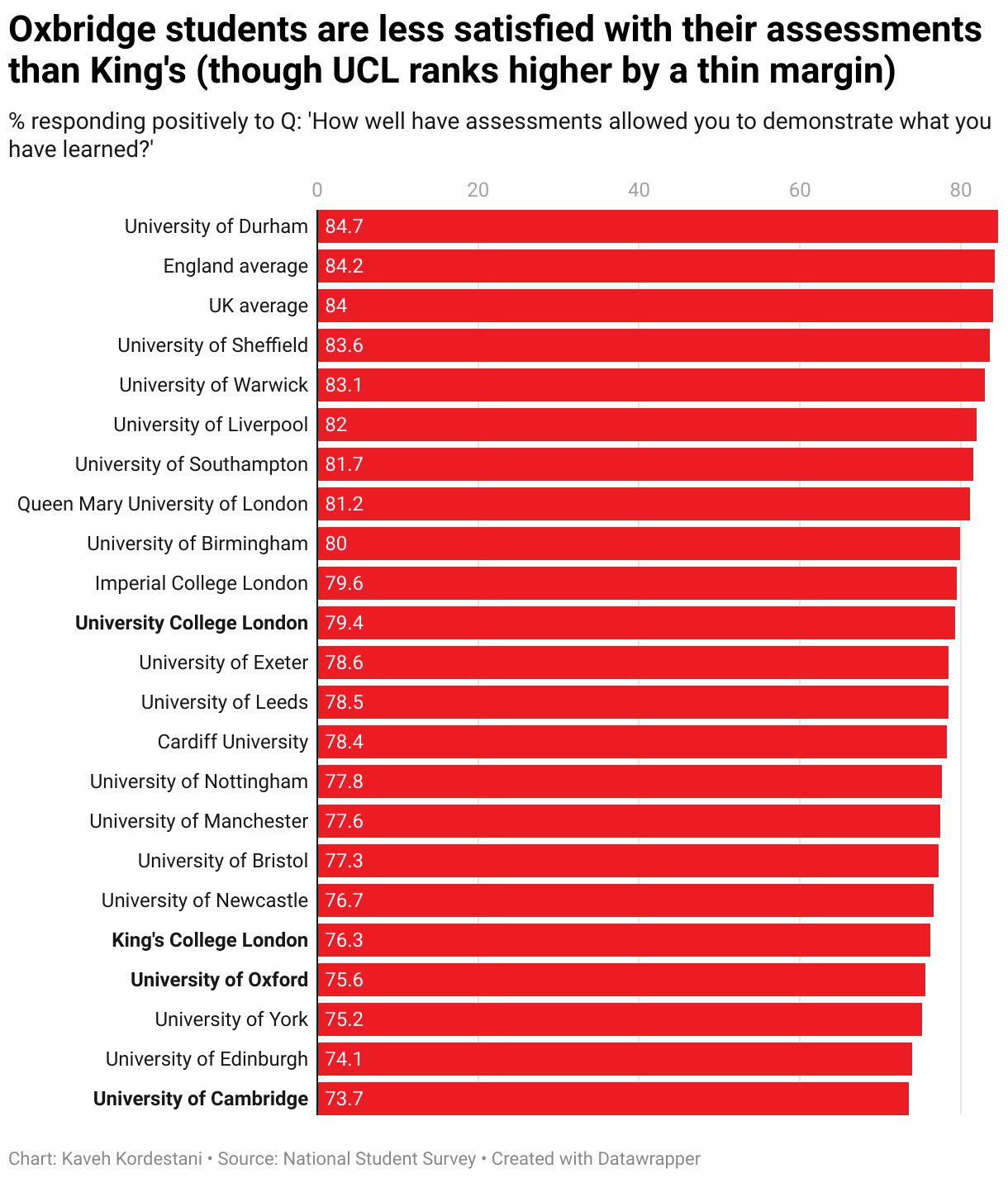
King’s has cited such data as a rationale for the assessment reforms, though there may be issues with this. The Russell Group range is just 11 percentage points. To add, both the Universities of Oxford and Cambridge also ranked lower than King’s for assessment satisfaction (75.6% and 73.7%, respectively); both universities have similarly introduced controversial assessment reforms this year.
In a statement to Roar, Professor Adam Fagan, Vice President (Education & Student Success) at King’s, said, “The ‘Transforming Assessment for Students at King’s’ (TASK) initiative has been developed in direct response to feedback from students and staff about the way coursework is assessed at King’s.
“Drawing on sector-wide best practice and a thorough consultation process, which is still ongoing, with student representatives and advisors, KCLSU, and Faculty staff throughout 2024 and 2025, we have created a framework designed to develop and demonstrate a wider range of skills and knowledge through assessments for students and staff.
“This framework sets out clear principles for good assessment and feedback, embedding consistency across programmes at King’s to support student excellence.”

Kaveh Kordestani is a staff writer for Roar