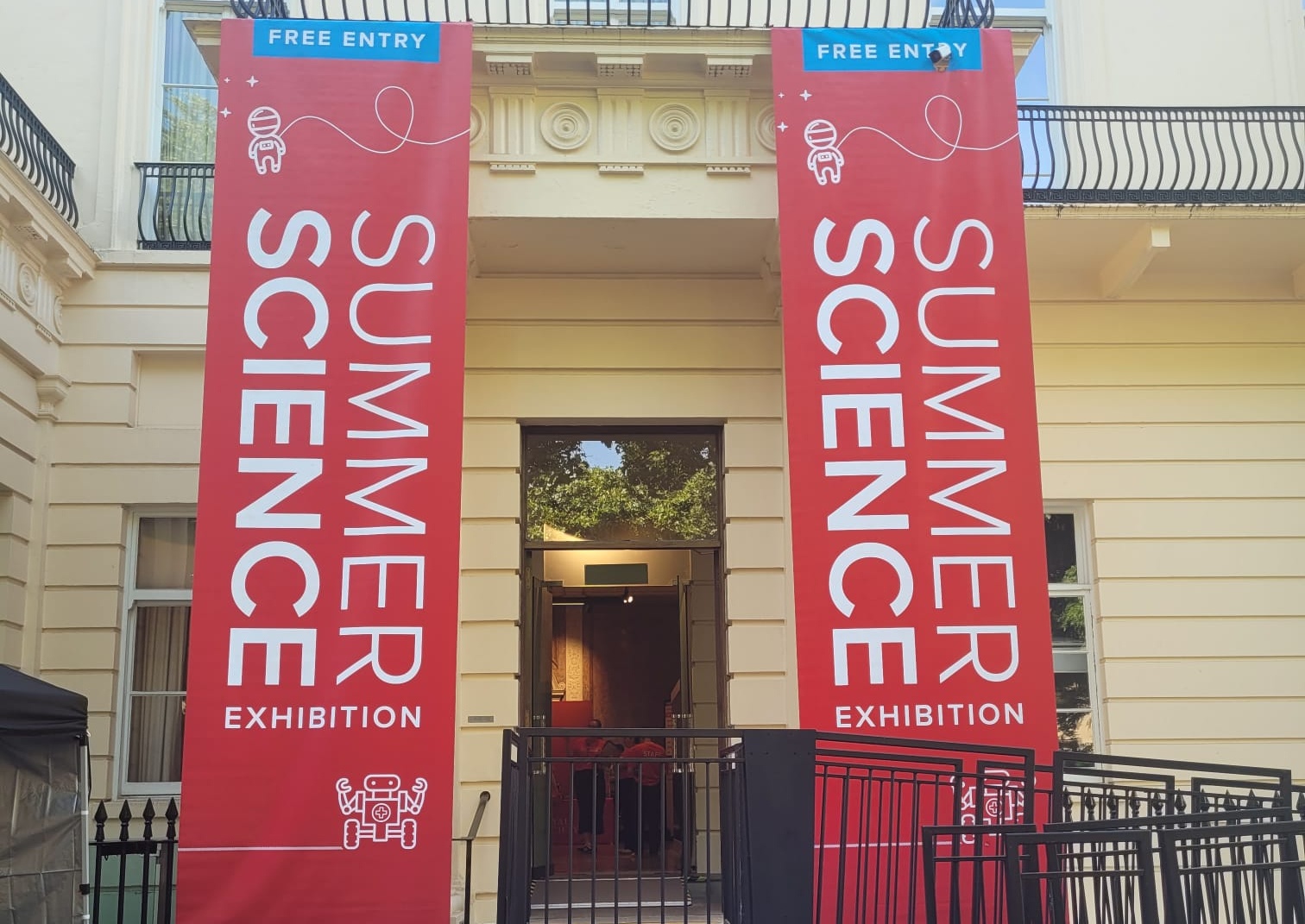
Science Editor Anoushka Sinha talks about the Royal Society Summer Science Exhibition, held from 1 to 6 July 2025, where King’s College London (KCL) researchers presented their work.
The free event was targeted at all ages, with the simple aim of showcasing the last year’s scientific advancements made across the country.
The exhibitions varied in subject matter, with some specialising in sustainability using fungi, biopolymers, and accelerated coal-formation processes.
At the very first stall of the event, was KCL’s own Aliaksandra Rakovich, explaining how her Nanoglow team uses nanotechnology and light waves to make chemical reactions more efficient.
The process of using light to speed up chemical reactions is called plasmonic catalysis and is applicable to creating a more energy-efficient world powered with lowered pollution levels.
Next door, volunteers from Oxford University showed visitors around the Quantum Zone. Using quantum entanglement, they are able to make PET scans more efficient so that patients do not need to be injected with excessive amounts of radiotracers.
Aside from sustainability, there was also a focus on medical advancements, with The Phage Collection Project handing out kits and teaching the public about the importance of research into phages – naturally occurring viruses which individually kill bacterial cells which could otherwise be deadly to humans.
The Square Kilometre Array Observatory (SKAO) showed off its ongoing work building radio telescopes around the world, hoping to detect massive objects in distant space.
The Royal Society also had a special Young Researcher Zone, where students from schools all over the country presented their own research on topics ranging from the acid tolerance of yeast, to naturally occurring Hydrogen in Cornwall.
This is not the first time King’s has taken part in the prestigious event; King’s researchers James Millen, Emilio Pisanty, and Margarita Khokhlova’s work was previously featured at last year’s Summer Science Exhibition.
About the author