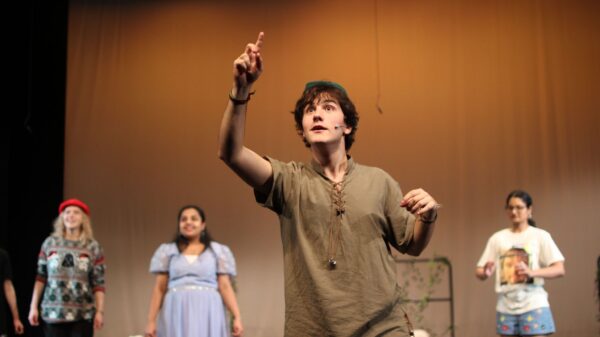
Staff Writer Cosimo Boothby examines the success of The King’s Players recent addition to their annual pantomime; Peter Pan.
From the loving bedroom of the Darling’s London home, The King’s Players presented their annual Panto on November 12th and 13th. Inspired by J.M.Barrie’s classic children’s tale of magic and wonder, KCL’s Evie Korten and Gi Guepel adapted Peter Pan for the Greenwood stage.
Watching my friends make utter fools of themselves whilst singing parodies of current hits was the best remedy for November’s spitting rain and bitter cold. I couldn’t help but think fondly back to every well-intentioned but ultimately vapid advertisement for the show on cast member’s instagram stories during ‘Gimmie, Gimmie, Gimmie a Shadow at Midnight’.

For those unfamiliar with the great tradition of Pantomime (‘panto’), it is a uniquely British form of musical comedy performed usually before Christmas. Its history stretches as far back as ancient Rome, but it’s been since influenced by the Italian Commedia dell’arte and the early English Mummer’s Plays. By the 18th century, this hybrid theatre established itself as a staunchly festive custom. In its modern incarnation, Panto is performed during the holiday season for families and hordes of school children. It features familiar fairy-tale plots, slapstick comedy, song and dance, proto-drag (the ‘dame’), and active audience participation.
Panto is not a production any actor, no matter how amateur, takes lightly. This not because the Pantomime is an integral part of British culture (though it is.) It’s because people are, often, cowards. The genre is loud, bawdy, and embarrassing—it wouldn’t be Panto otherwise—and it forces a performer to reject the nagging stings of shame and leap blindly into the genre’s burlesque debauchery. For no one is this more felt than for Luis Felipe B. de Mello, playing the titular role. Luis brilliantly hit the cheekier notes within the iconic Peter Pan, while offering the traditional charming boyishness of the 1953 Disney adaptation.

A common symptom of the amateur dramatic actor is a subtle discomfort on stage. It is hard to diagnose, but easily sensed. The ailment often worsened in comedy. Some talented few escape such a fate. One such student was Anushka Sabhanam (Wendy). Sabhanam owned that stage; she stood firm as innuendos and cliches fired, and she was clearly one of the most professional performances in the production. I have seen and acted alongside Sabhanam many times, but I had yet to see such glowing confidence till now. Wendy was an obvious fit.

The Dame (Theo Bonding) was comparable only to a languid Nigella Lawson, balancing both innuendo and blatant filth. Bonding achieved some of the biggest laughs of the night with a surprising laissez-faire approach to ‘damehood’. While given an assortment of expertly written lines (I must compliment the triple entendre on ‘neverland’), Bonding sometimes suffered from a lack of projection, which hindered his normally incisive comic impact. However, with this being Bonding’s first appearance on a KCL stage, and considering his debut in such a large role, his amateurism of Greenwood’s acoustics was forgivable.
In fact, volume seemed the biggest fault of the production. It is hard to tell if this was a tech or actor issue, but it often affected the reaction to Korten’s funny, fast, and witty writing. Having already read the excellent script beforehand, it was a shame some of the funniest lines didn’t receive the laughter they deserved.
The Lost Boy duo, Cream (Kristina Krajnovic) and Sugar (Aaron Toischer), stood out in the ensemble. Not only did they lead the traditional Panto sing-along (and following contest), but Krajnovic surprised us with an impressive Chappell Roan rendition, and Toischer carried the slower moments of the production with an energetic but concrete performance. Similarly I thought McFunt (Ananya Sahay) was an unsung hero, offering some of the funniest reactions and line-readings of the Panto.
Special note must be paid for Korten’s last-minute step-in as Smee. Alongside being co-director and co-writer, they gave an impressive performance as a last-minute add-in to the cast. Though one wonders: will there ever be a Korten act without the signature comedic breathless entrance?

Transforming Greenwood’s lecture hall/theatre into a children’s bedroom and then into the adventure-prone island of Neverland is no small feat – but the set’s surprisingly inspired and effective use of three bedshaped platforms easily passed such a hurdle.
One of the production’s strangest charms was its relentless cycle of set changes. The lights would drop, the curtain would creep down to a half-remembered Sinatra instrumental, and a minute later it would rise again to reveal only the slightest tweak to the stage. This happened six or seven times, each more unnecessary than the last, and the repetition became its own joke. The play on nostalgic music inspired the crowd, through laughter, to sing along Sinatra—trying and failing to remember all the lyrics.
Ultimately, this year’s Peter Pan stood out because it resisted the usual student-theatre urge to be self-serious. The King’s Players leaned into what panto does best: unabashed comedy, festive fun, and an open invitation to the audience. Korten’s closing speech – recalling childhood trips to the theatre and the uncomplicated joy and inspiration they brought – embodied that ethos. Under the direction of Evie Korten and Ishani McGuire, the show understood that panto doesn’t need polish to work; it needs generosity, and this production had it in abundance.