An investigation by Roar can reveal that King’s College London (KCL) held investments in companies involved in the procurement of white phosphorus for the production of munitions. One such company, ICL Group Ltd, exclusively held the US government procurement contract for white phosphorus until its expiry in March this year. The University, responding to Roar’s investigation, said it has “raised these issues with the funds and [is] seeking further clarification”.
According to a Freedom of Information Request by Roar, received in October, King’s holds a minor investment of £5,320 in ICL Group, formerly Israel Chemicals Ltd, an Israeli-owned chemical company. ICL Group’s wholly-owned US subsidiary, ICL-IP America Inc, earlier this year saw the expiry of a five-year contract with the US Department of Defense for the procurement of white phosphorus to be processed into munitions at Pine Bluff Arsenal. According to its website, Pine Buff Arsenal, a military installation in Arkansas, is “the only place in the Northern Hemisphere where white phosphorus munitions are filled”.
KCL’s Ethical Investment Policy, introduced in November 2024 following the publication of KCL BDS Forum’s report into the University’s alleged complicity with alleged war crimes committed by Israel in Palestine, pledges that King’s will not “hold any direct or indirect investments in companies deemed to be engaged in controversial weapons”.
The policy defines such weapons as “cluster bombs, land mines, depleted uranium weapons, chemical and biological weapons, blinding laser weapons, non-detectable fragments, and incendiary weapons (white phosphorus).”
According to publicly available US government spending records, ICL-IP America Inc, a subsidiary of ICL Group Ltd, has intermittently supplied white phosphorus for the manufacture of munitions at Pine Bluff Arsenal through various subsidiaries and contracts since 2008, when public spending records began. ICL-IP America Inc has held the sole US government contract for the procurement of white phosphorus for use in the manufacture of munitions since 2020.
A King’s College London spokesperson said:
“A specialist agency screens King’s investments (which are held in funds and are not made directly into companies) to avoid exposure to companies where revenue is made from controversial weapons, including but not limited to the production of biological or chemical weapons or nuclear weapons.
“None of the companies identified in this article – ICL (held indirectly via Northern Trust World Climate Equity index fund) and TATA Elxsi (held indirectly via the Acadian Sustainable Emerging Markets Ex-Fossil Fuel fund) which in total represent less than 0.018% of our portfolio – has been identified in the screening process as breaching our investment exclusions however we have raised these issues with the funds and are seeking further clarification.”
Alleged White Phosphorus Use on Civilians in Gaza By Israel
In October 2023, Amnesty International’s Crisis Evidence Lab alleged that Israel used white phosphorus munitions against civilian populations in Gaza.
Human Rights Watch (HRW) also confirmed reports of the use of white phosphorus munitions by Israel on densely-populated areas of Gaza on 11 October 2023, verified using video and witness evidence.
HRW stated, “The use of white phosphorus in densely populated areas of Gaza violates the requirement under international humanitarian law to take all feasible precautions to avoid civilian injury and loss of life.”
The Israeli military denied all accusations of the use of white phosphorus munitions in Gaza as “unequivocally false”.
The Israeli military later admitted to possessing white phosphorus munitions which it said were “intended for camouflage, and not for the purpose of attacking or starting fires.”
This admission comes despite the fact that, in 2013, the Israeli military had announced plans to phase out white phosphorus smokescreen munitions following its 2008-2009 offensive in Gaza, which had drawn war crimes allegations from several human rights groups.
Images taken by international journalists on 9 October 2023 and verified by Amnesty show missiles labelled with the US Department of Defense identification code for white phosphorus munitions, positioned in Sderot, Israel, near the border with Gaza.
Videos posted on social media, later in October, appear to show the use of white phosphorus munitions in densely-populated civilian areas, including a hotel and near a harbour in northern Gaza.
It has not been established whether the US Department of Defense-labelled white phosphorus munitions allegedly used in Gaza and Southern Lebanon were produced using white phosphorus procured by ICL-IP America Inc.
The Australian Broadcasting Corporation (ABC) reported in June 2024 that ICL Group initially denied any involvement in supplying white phosphorus to weapons manufacturers when the broadcaster requested a statement. After providing information about US government contracts to procure white phosphorus for munitions, ICL Group accepted that such an arrangement had been in place but said it ended its supplies to the US Department of Defense before 2025.
In a statement to ABC, ICL Group said, “We ceased supply last year [2023], and the US Army was notified.”
The last delivery of white phosphorus to Pine Bluff Arsenal by ICL-IP America Inc was reported in December 2023, according to US government spending records.
According to international law, white phosphorus munitions may be lawfully used as smoke, illumination, or signalling weapons, but not intentionally as incendiary weapons against civilians or in densely-populated areas.
The investment comes against the backdrop of a new and devastating phase in the decades-long conflict between Israel and the Palestinian territories, which remain under Israeli occupation.
The current phase of the conflict was triggered on 7 October 2023, when Hamas led a terrorist attack on Israeli territory, during which some 1,200 people were killed and 250 taken hostage to Gaza.
Since 2023, at least 68,500 people have been killed by the Israeli military, including at least 18,457 children, according to the Hamas-run Ministry of Health, whose statistics are recognised by the UN as reliable.
After a two-year investigation, a UN Independent Commission found in September that Israel’s actions in Gaza constitute a genocide.
The Commission’s chair, Navi Pillay affirmed, “Israeli authorities have persisted and continued with their genocidal campaign in Gaza for almost two years now,” urging Israel to “immediately end the genocide” and “comply fully with the orders for provisional measures of the International Court of Justice.”
Trigger warning: The following paragraphs include graphic detail about the injuries caused by white phosphorus munitions.
The Human Toll of White Phosphorus Use
Human Rights Watch (HRW) described the devastating effects of white phosphorus in stark terms, noting that “upon contact, white phosphorus can burn people, thermally and chemically, down to the bone as it is highly soluble in fat and therefore in human flesh.”
HRW added that “white phosphorus fragments can exacerbate wounds even after treatment and can enter the bloodstream and cause multiple organ failure,” while “already dressed wounds can reignite when dressings are removed and the wounds are re-exposed to oxygen.”
These injuries are often fatal, as “even relatively minor burns are often fatal,” and survivors face long-term suffering, as “extensive scarring tightens muscle tissue and creates physical disabilities.”
Beyond the physical impact, “the trauma of the attack, the painful treatment that follows, and appearance-changing scars lead to psychological harm and social exclusion.”
Further University Investments Show Entanglement in Occupation, Deportation and Defence Industries
As revealed by KCL BDS Forum in 2024, King’s held significant investments in companies involved in the occupation of the West Bank and East Jerusalem, illegal in international law, as well as connections with the defence industry.
Via a Freedom of Information Request received in October, Roar found that the University still holds more than £350,000 of investments in several companies directly listed in the UN’s blacklist of companies involved in the occupation of Palestine.
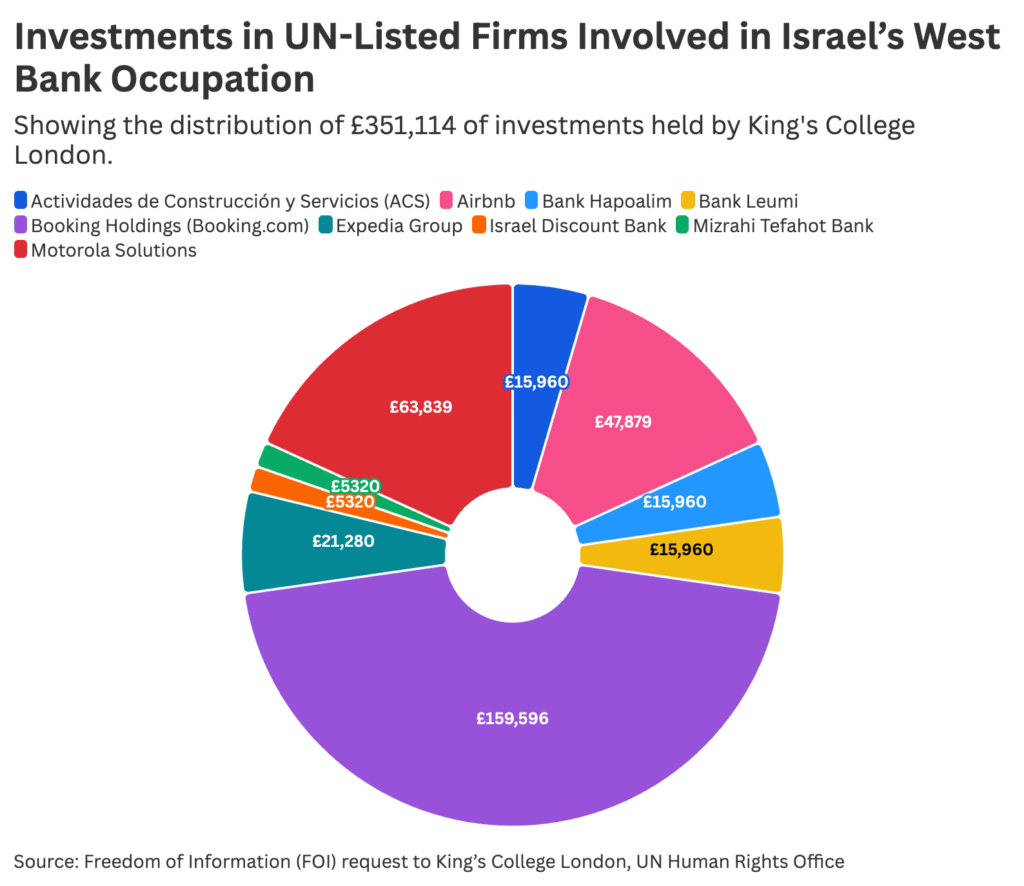
According to the UN database of companies involved in Israeli settlements in occupied Palestine, these firms have been implicated in a range of activities that support or facilitate the occupation of the West Bank and East Jerusalem.
ACS has been cited for involvement in construction and infrastructure projects in settlements. The company has not made any public statements in response to its listing on the UN database.
Airbnb, Booking.com and Expedia are among travel companies which The Guardian reported “had been accused of financially benefiting from the Israeli occupation, by listing rooms in settler-owned houses and guesthouses in the Palestinian territories.”
Airbnb initially delisted all properties owned by Israeli settlers in the Israel-occupied West Bank following the publication of the UN database. Later in 2019, Airbnb reversed this decision after Israeli lawyers brought a class action lawsuit against the company for religious discrimination.
Airbnb stated, “We will continue to allow listings throughout all of the West Bank, but Airbnb will take no profits from this activity in the region.”
It continued, “Any profits generated for Airbnb by any Airbnb host activity in the entire West Bank will be donated to non-profit organizations dedicated to humanitarian aid that serve people in different parts of the world.”
In a statement to AFP, Booking.com said it permits “all accommodation providers worldwide to list on our platform as long as they are in compliance with applicable laws.”
In a statement to Reuters, Expedia said, “We connect travellers with independently operated accommodations, including some in disputed areas. These listings are clearly labelled, comply with international laws and sanctions, and undergo enhanced due diligence guided by UN standards.”
Several Israeli financial institutions – including Bank Hapoalim, Bank Leumi, Israel Discount Bank and Mizrahi Tefahot Bank – have provided loans and financial services to settlement authorities and construction projects.
In addition, Motorola Solutions supplied the surveillance and security technology used in settlements and at checkpoints throughout the West Bank.
Motorola has not issued any public response addressing its inclusion in the UN database.
King’s College London has not provided any comment on its ongoing investments in these companies.
King’s also invested £159,596 in Palantir Technologies Inc, a US data analytics company often criticised for its government and military contracts.
According to leaked internal messages obtained by 404 Media, an independent online publication, Palantir is involved in the logistics and technology behind US President Donald Trump’s controversial Immigration and Customs Enforcement (ICE) deportations, which have been criticised by the Office of the United Nations High Commissioner for Human Rights (OHCHR) for potential human rights violations, including the deportation of individuals to countries where they may face torture.
404 reported that Palantir’s technology has been used in “finding the physical location of people who are marked for deportation.”
Business Insider also reported in April that ICE had closed a $30 million (£23 million) deal with Palantir for software to “track self-deportations and immigrants who have overstayed their visas”. The outlet did not receive a response to a request for comment.
According to a US government press release, 527,000 people have been deported so far since the beginning of President Trump’s second term in office.
The deportations have been widely criticised by media and human rights organisations for incorrectly deporting individuals who were wrongly identified as undocumented migrants and removed despite having legal residency or citizenship status.
The Nation reported that AI technology developed by Palantir has been used by the Israeli military to identify targets in Gaza.
A King’s College London spokesperson said that Palantir had not been identified as breaching the University’s investment exclusions.
King’s also holds a £13,070 investment in TATA Elxsi, excluded from the Netherlands National Civil Pension Fund, for its indirect involvement in the manufacture of nuclear weapons primarily through its parent company, TATA Group. Investments in companies associated with the production of nuclear weapons are prohibited by KCL’s Ethical Investment Policy.
A spokesperson for King’s College London said that its investment in TATA Elxsi, held indirectly via the Acadian Sustainable Emerging Markets Ex-Fossil Fuel fund, has not been identified in its screening process as breaching its investment exclusions.
A spokesperson for KCL University and College Union (KCL UCU), which is currently involved in a local trade dispute with the University, partially over these investments, said:
“Roar’s investigation shows that the exclusion of ‘controversial weapons’ does not go far enough in preventing KCL investment in companies implicated in genocide.”
The union branch said that in June, it had “formally presented evidence and recommendations to the Finance Committee of KCL Council,” including “immediate divestment from all companies that operate in illegal Israeli settlements, along with military-supplying technology companies that have publicly supported Israel’s war on Gaza.”
They added that they had also “proposed adding exclusions to KCL’s Ethical Investment Policy” to prevent investment in “arms companies more broadly” and those “implicated in human rights abuses and violations of international law.”
“The Finance Committee rejected all of these recommendations,” the statement continued, adding that KCL UCU has now “expanded its formal trade dispute with management” and is “balloting members on possible industrial action.”
As part of its dispute, the branch said it is seeking to advance its “divestment demands,” including “a clause to staff contracts that would allow them to conscientiously object to activities that would make them complicit in genocide,” and to increase “ordinary staff representation on KCL Council,” the institution responsible for decisions regarding the University’s investments.