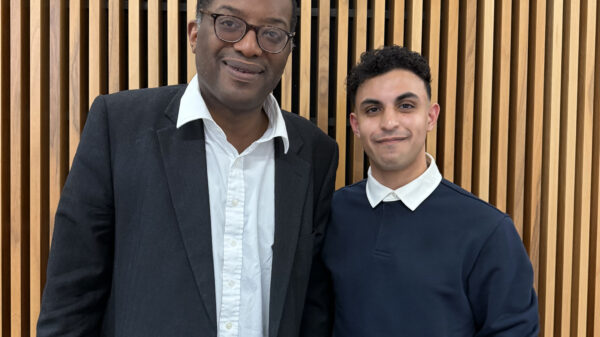
Staff writer Isabella Steiner discusses the role of journalism amidst the geopolitical instability with a former reporter for BBC World News, Nik Gowing.
Global relationships between nations are becoming brittle with each passing minute. With a Russia-Ukraine war approaching its 6th year, the exacerbation of political extremism and the acceleration of climate-induced catastrophes, any certainty over international peace is quietly eroding.
Political figures such as the former Polish prime minister Mateusz Morawiecki have been vocal about this. However, only a few people understand these geopolitical prospects better than Nik Gowing.
Having over 30 years of experience as a BBC television broadcaster and Channel Four News diplomatic editor, Gowing has been witness to sudden reconfigurations in both the newsroom and in the political landscape. These include but are not limited to the fall of the Berlin Wall, the attack on the Twin Towers on 9/11 and the Eastern European revolutions of 1989. He refers to these as the “unthinkable”, a term he coined for his organisation, “Thinking the Unthinkable”. This organisation focuses on preparing leaders to address unforeseen circumstances.
However, with the recent changes, instead of referring to it much as the “unthinkable”, he has described these events as “unpallatable,”. He warns of the danger of ignoring the various systems individuals rely on.
“It’s a far more binary world we’re entering, and it’s happening amazingly quickly” – Nik Gowing
Gowing emphasises that a large portion of people are not prepared to grasp the erratic reconfiguration that the world faces. He holds the climactic disasters that we already grapple with as evidence. However, the threats he refers to are much more foundational to the general standard of living. Accessing groceries, communicating with one another, and powering homes remain some of the few privileges which are functioning on borrowed time and might not be guaranteed.
Climactic disasters and unstable global leaders
In May of this past year, several UK-based retailers, including Co-op, Harrods, and M&S, were targeted by ransomware attacks. This left the supermarket chains unable to process contactless payments and website orders, consequently leading to stock shortages and delivery delays. According to Cisco’s annual cybersecurity Readiness Index, these attacks are not expected to cease. This is supported by the data, where only 4% of UK organisations achieved a mature level of readiness to handle these attacks.
When Gowing raises his voice about these threats, it does not stem from baseless pessimism or “doom-mongering”. It derives from decades of observing a bipolar world order throughout the latter 20th century and refining his discernment of geopolitical instability. “When we predicted Brexit would be voted for, and that Trump would be nominated and elected, people thought we were smoking something. Look at where we are now.” He further recalls predicting Putin’s invasion of Ukraine in 2022. He highlights the disbelief of leaders, including the former Secretary General of NATO, when warnings about the invasion were issued.
And yet, it is not exactly the blatant attacks carried out by world leaders such as Vladimir Putin and Donald Trump that are increasing the vulnerability of society’s systems. “Look what’s happening with the climate. Look what’s happening with biodiversity in nature. That’s bad enough.
We’ve had massive floods in Wales, and it’s going to keep happening.”
Gowing’s expertise lays the cards clearly on the table; society has already surpassed an ecological and technological threshold that is difficult to go back from.
Is disregarding the threats an obstacle to preparing us for the “unpalatable”?
On a collective level, individuals seem to hesitate in discussing the possible destabilisation of society’s systems. Few news organisations and politicians wish to publicise information that may increase the risk of inducing anxiety among citizens.
The discomfort of these prospects, however, can hinder awareness and adequate preparation. According to Gowing, society brims with the technological resources to fight against these prospective threats, but fails to have the mental resilience.
However, he does not condemn citizens for avoiding conversations about the current status quo. Instead, he recognises this as a convenient option that distracts from serious psychological anxieties.
“Of course, if you think about it all the time, you go to go to a catastrophic meltdown, which is why it’s much easier to go to a pub, get a glass of beer, have a good family with your friends, go to Glastonbury, go to a rock concert and say tomorrow’s another day.” – – Nik Gowing
Yet, this is not a question of whether individuals can prepare for what he calls the “Unpallatable.” Gowing shares the conviction that it is more of an imperative rather than a choice.
“It is not a question of, can they prepare? they need to prepare.” – Nik Gowing
The Failure of Modern Journalism in Spreading Awareness
In a period where time and the overflow of information overpowers the rapidity of journalists’ reporting, being a reporter will be less about the privilege of storytelling and more about verifying information. Gowing shares his disillusionment and scepticism when he reads the news.
“Quite often, I see stuff being written as a fact, and I can deduce that it has not been adequately sourced, adequately checked, or is a repeat of what someone has read on a website, which has not been validated.” – Nik Gowing
The fragmentation and the fraught ethos of the current journalistic landscape concern Gowing. He expresses his disappointment with what the industry has become. “I think journalism is now as much about opinions as it is about facts, and that it is complicating it very dramatically.” He advocates that qualitative journalism should be reporting on these threats. These include cyberattacks, the critical state of the climate, and the unthinkable. Yet it has failed to fulfil its job in doing so. News organisations do not wish to alarm citizens due to not wanting to incite fear. He adds, “good journalism does not necessarily mean that people want that information”.
There is also scepticism about news organisations prioritising profit and crowd-pleasing over publicising the hard truth. He believes that journalism is not reporting on uncomfortable threats to society because it “does not sell newspapers and pisses people off watching the 10 o’clock news and being told about another catastrophe.”
As a result, Gowing believes that journalism will require the skill of fostering conversations between people more than before.
“I think one of the tragedies, one of the real threats to journalism, as we know it, or traditionally assume, is the fact that many of your generations think that everything in journalism appears on the screen as opposed to knowing how to ask questions and having human beings to talk to” – Nik Gowing
How Do We Prepare for These Threats?
In a world order which he categorises as “potentially overwhelming,” Gowing makes it clear that it is about “survivability”. And yet the lack of discourse and awareness about the threats leaves citizens without a manual for how to prepare.
Our dependence on technology seems to be an obstacle to building mental resilience for any unpalatable shifts in society. Most of modern life is enshrined in technological systems such as online payment, social media, and email. This advances our practicality, but this has also hindered the fabrication of good leadership skills and mind muscle.
“If the Wi-Fi goes down, and you can’t use your laptop, have you got another way of communicating with people?” Gowing asks. He underlines the fact that technological communication is impermanent and unstable. Preparation, according to him, may lie in the analogue.
He recalls the convenience during his studies: “contact lists, a Filofax, an ATZ, Aerodex, where he can always go if he wants to find telephone numbers from 30 years ago.” None of these, he makes clear, can be a subject of vulnerability if there are cyber attacks or if society becomes estranged from electricity.
Future Outlooks
Gowing was a key speaker at the TEDxKingsCollegeLondon event that took place on the 27th of November. He spoke in hopes that the publicisation of his message would aid in mobilising awareness of his warning.
“This is where the word hope comes in,” he tells Roar contemplatively. He emphasises that his desire ultimately lies in making his message reach those who are not thinking about the destabilisation of the world.
Gowing leaves it clear: if everything we have—or take for granted is now under threat, then acknowledging destabilisation, despite it seeming futile, can be the first act toward real survival.