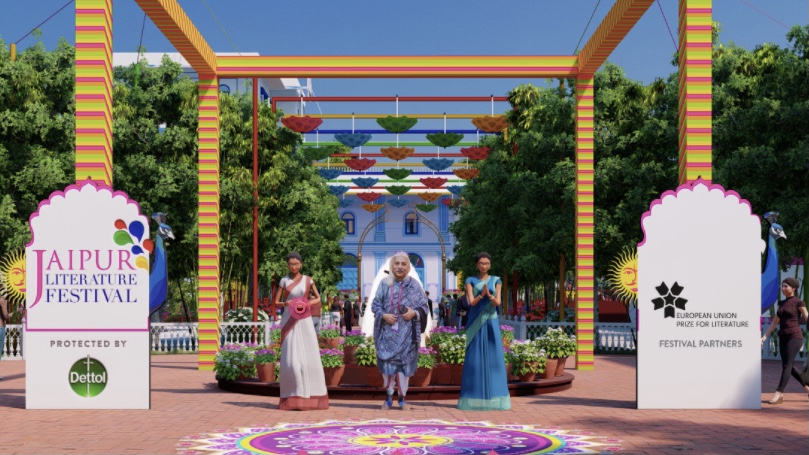
Roar writer Amaaya Nath discusses the Jaipur Literature Festival and its importance on an international scale.
In India, the Jaipur Literature Festival, the world’s largest free festival, is now underway. The event has 300 speakers representing two nationalities and includes many Nobel prize winners, industry leaders, and authors. As such, it is no surprise that it is considered the greatest literary event on earth.
Normally the festival takes place in the iconic Diggi Palace in Jaipur (India), attracting a crowd of 400,000. This year the team at Teamwork arts have done a fantastic job at replicating it as an online experience, complete with a 3D Durbar hall for events. However, what surprises me is the lack of interest from foreigners when I speak about this. It seems as though this is regarded as an “Indian event†where it seems appealing only to Indian audiences because of so-called cultural differences.Â
The reason why this event means so much to me is because it gives a platform for many Indian authors and speakers that otherwise get overlooked. The main perception of Indian literature internationally is still one of writing back to the west, or Indian patriotism after colonialism. Yet this is far from the truth. Indian experiences and voices relay truths about our world and the societies we live in, and talk about important motifs worldwide, such as struggles with identity, feminism, nationalism and diversity. It means so much hearing about new groundbreaking ideas from other people of colour.
Having studied History in the UK, I have always been taught by white voices that often overlook the realities of the past. When I attended a talk about Jinnah (a freedom fighter), he explained and broke down the nuances of the partition which is often left out in national curriculums. The best part of it is that the festival is completely free. Events of this magnitude in the west are often taken as a given to be watched by people of all nationalities, yet it is beyond me how JLF is written off as an Indian only event.
This isn’t limited to Indian voices; JLF has attracted many internationally notable speakers such as Bill Gates, Malala Yousafzai, and Priyanka Chopra. While these big names attest to the magnitude of the festival, JLF is about the love of literature – not just Indian problems or big names.
The festival runs until 28th February. I’d encourage everyone to look at the programme, which is available here.
About the author