It may seem strange that pensions are on the agenda of a student newspaper. Yet, this week’s strikes present the latest disruption in the protracted dispute over controversial and unprecedented pension reforms. Universities UK (UUK) are pushing to increase the contributions staff make (which have already risen incrementally) and for cuts to future retirement benefits, in order to close a reported multi-billion pound deficit in the Universities Superannuation Scheme (USS) pension fund. Amid a trend of real terms pay cuts and insecure contracts, stretched and fed-up staff are not reticent about their plight to protect their income, both now and in retirement.

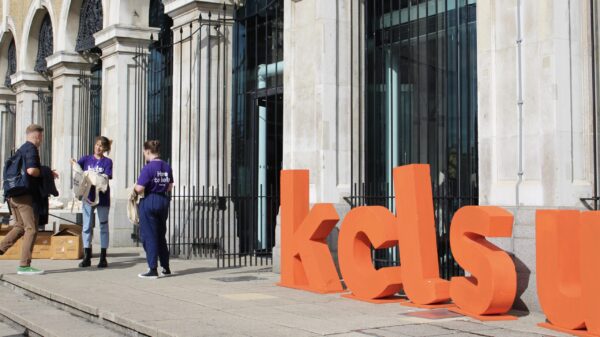
Union placards placed outside Strand campus on the first day of strikes on Wednesday. Credit: Nadya Oppenheim

Members of KCL staff and UCU stand together as part of the picket on the Strand. Credit: Nadya Oppenheim
The level of polarisation would be surprising, were the stakes not so high. For the third time in the space of a few years, strikes have resulted from a repeated failure of USS, UUK, and the University and College Union (UCU) to agree on a sustainable, acceptable, and affordable plan for pensions for staff in retirement. USS have an ‘exclusivity clause’, meaning staff cannot be offered another pension by the university if they decide to opt out of USS.
A key part of UCU’s ‘Four Fights’ campaign is to protect pensions, with Dr Jo Grady writing that “cuts to USS since 2011 have already left the typical member of staff £240,000 worse off, and now, employers are trying to force through a 35% cut to guaranteed retirement income.”Â
USS, the UK’s largest pensions provider, and UCU, a trade union representing all staff eligible to join USS, not only disagree about the best way forward, but are at loggerheads over the very procedure of valuing the offsetting assets and liabilities of the pension fund.Â
In a statement which continues in full further on, Professor Adam Fagan, Interim Vice President (Education) at King’s College London (KCL), told Roar, “It is not an option for us to opt out of the pension scheme. The fact is that the USS trustee who runs the scheme, has decided that more money is needed, so we must continue to engage in national discussions in order to ensure that it remains affordable and good value for our staff.”
URGENT USS PENSIONS NEWS:
Today @UniversitiesUK voted to push ahead with its plans to cut thousands of pounds from the retirement benefits of university staff in the USS pension scheme
1/
— UCU (@ucu) August 31, 2021
In @ucu's dispute letter to @USSEmployers VCs????, we noted that, if the UUK cuts go through, a typical academic, aged 37, would experience a 35% cut in the guaranteed DB pension built up in future & the cut would remain at 23% if extra DC income was converted into DB pension. 1/3 pic.twitter.com/NhdPu5KnNT
— Michael Otsuka (@MikeOtsuka) November 22, 2021
UUK issued a statement expressing “willingness to consult employers on any viable, affordable and implementable alternative proposal from the UCU”. The alternative plan put forward by the staff trade union would entail universities contributing 3.8% more than they do currently, and members of USS 1.5% less than they do currently. UCU’s dispute letter to USS employers read, “the UUK proposals will mean a USS member aged 37 earning £41,526 (the current starting salary for a lecturer in many institutions) can be expected to go on to build up an annual guaranteed pension of £12,170 if they continue to work full time in the sector until age 66. This compares with the £18,857 annual income which they would build up under the current arrangement. The same 35% cut would also apply to the guaranteed cash lump sum which the member would receive they they retire. Even when the expected extra cash is included into this member’s defined contribution (DC) pension pot and then converted into the USS defined benefit (DB) pension, the cut from the UUK proposals remains at 23% of pension income.â€
On the picket line, Dr David J. E. Marsh, a lecturer in the Physics Department, told Roar, “I was contributing to USS for 3 years before I left in 2017 and I was feeling good before about returning to the USS scheme, but now I don’t feel good about my retirement. I’m 34 so I have more time to accrue the much smaller 1/85th per year, so this affects me a lot. When returned to the UK I was like ‘I’m unionised, great, just in time to help with the 35 per cent pension cut.’ [professors are civil servants in Germany and cannot strike] I’ve been lucky in the sense that I haven’t been affected by many other issues of the strike, but I see people all around affected by casualisation, workload, and pay gaps, and the strain put on people socially and mentally.”
A member of staff at King’s told Roar of their experience working in higher education: “My first contract at a university was for 22 months instead of 24 which meant that not only was I not paid during the summer, but also that I was 2 months short of an entitlement to unemployment benefits. Since then, I spent a lot of time applying for jobs on jobs.ac.uk, the platform for academics, and followed the visible and rapid decline in job offers, full time positions and pay while at the same time student tuition fees were going up sharply (instead of being abolished).
“I did what many of those working in academia have to do: working for many years on a variety of short-term contracts for a few months, on fractional contracts rather than full-time contracts, neither of it [sic] by choice. Many of my colleagues are on hourly paid contracts, which means even greater job insecurity and less money for the same amount of work. Starting paid work often later because of university studies and a PhD, working on fixed-term contracts, and part-time contracts (always working more hours, unpaid hours, than on the contract) makes thinking about the pension already scary. But a drastic cut in the pensions of 25%, if not more, might well mean poverty.”
The UCU has published both a UUK pension change modeller and a HE pay modeller. On the picket line, a member of staff in their early forties and in the School of Professional and Continuing Education said he had consulted both UCU and USS websites about his future pension payments, “and USS’ [pension modeller] paints an even bleaker pictureâ€. He is set to lose “about a third†of his annual pension if the proposed UUK changes are implemented, from approximately £24,000 per annum down to £16,000 or £17,000 a year. Furthermore, “it’s insecure. The main thing for me is the valuation was done in March 2020. We have to go back to the drawing board with a new valuation. Yes, we might have to make changes to pension scheme but not in this way.â€
James Ackroyd from King’s International Foundation said: “We don’t teach because we want a great deal of money but it would be nice to be able to have a semi-comfortable retirement. That’s if you go into public service, you expect security. Since 2008 it’s been progressively getting worse. It will have big impact. I’ll have to put off retirement ’til I’m 70 maybe, who knows. They have tried negotiating over a long period time but haven’t come up with joint way of negotiating: it’s all smoke and mirrors.â€
Whilst most defined benefit schemes in the UK are closing for new members, USS is in the 11% of schemes still open to new members. USS first predicted a future deficit in 2017, where current contributions by staff and universities do not add up to the amount promised for a stable income in retirement.Â
In response to the USS valuation, UUK has put forward proposals for increases in contribution rates and reductions in future retirement benefits for staff. In October, the Russell Group released a video, “USS – and the question of ‘affordability’“, conceding that “pension contributions have been increasing for a number of years for staff and employersâ€, adding that they “will increase again unless changes are madeâ€. It continues that “Without the compromise, total pensions contributions would increase by as much as 85%, with your pension contributions, and those of employers, increasing substantiallyâ€. The Russell Group stated a typical university would have to pay an extra £30 million to the USS and that “a typical member [on an annual salary of £50,000], they might see monthly pension contributions increase from £400 to £780â€.
Learning time lost – KCL response says complaints on ‘case-by-case basis’
Regarding the strikes, one student said: “Of course I’ll be crossing the picket line, and using the facilities†as this doesn’t make a difference to the pensions, pay, and conditions crisis anyway.
“The fact is we’re paying, have paid, or will pay, for a service which strikes deny to us. They shouldn’t have to strike. As a third year, after strikes in first year, second year mostly in lockdown, and now this, it’s highly enervating to have your education disrupted.â€
The Office for Students has pointed out that because universities are subject to consumer protection law, they should consider how to make up for the disruption caused. When asked if KCL will consider refunding students for disruption caused, Professor Fagan, told Roar, “We are working closely with faculties and departments to provide support and help to ensure that students are not academically disadvantaged and continue to receive the best possible experience at King’s.
“We are focused on doing everything we can to minimise the impact of industrial action on teaching and learning. The university remains open, and students continue to have access to the facilities and services on campus including informal study spaces, libraries and computer rooms.
“Not all programmes are impacted by industrial action because not all staff are taking part and this means any potential impact is variable and specific. As we are seeking to apply mitigations, the university is not making any general changes to tuition fees as a consequence of industrial action taking place.
“Where a student feels that their education has been impacted, there is a right to complain through a formal process. Complaints are always considered on their own merits, on a case-by-case basis and outcomes will be specific to individual circumstances. This will include consideration of the ways in which mitigation may have been applied where teaching had not taken place.
“Students can find further information and updates regarding industrial action, the steps we are taking to mitigate the impact on student learning and experience, and the wellbeing support available on Student Services Online and the Student News Hub.”
In both semesters of the academic year 2020-21, there were 174 stage 2 complaints (30 from undergraduates and 114 from postgraduates), of which 10 were escalated to a stage 3 complaint.
Students point out that they are negatively impacted by the strikes but they are not the people responsible for the pensions and conditions crisis in higher education. Nor are they the people, although perhaps are part of the generation, who are going to fix the problems which the strikes target.
Striking staff point out that this industrial action is a last resort. UCU campaigns also target a lack of job security and excessive workloads, which risks impacting the quality of teaching.
A lecturer in the history department said, “my primary personal concern is with the precarity of many posts at King’s and other universities – including my own – as well as the effective pay cuts we’ve had since 2010 and the workload. I’m on a fixed-term one year contract with a heavy teaching load and no security, so I need to spend a lot of time applying for jobs, time I could spend on teaching and research if I were in a more secure position.”
A staff member in the Department of Comparative Literature has recently been awarded a permanent contract. However, they’re “striking because pay has not kept up with inflation and pay is disproportionately low compared to other sectors. The increased workload means we cannot offer extra mentorship to students because the pension scheme is eroding the defined benefit component. So if I work up until 65 years old I’ll have a guaranteed annual pension worth £11 000. And I have to contribute more now. In 2018 we won the pensions strike, so my hope is that negotiations can reopen with more concessions to protect defined benefits. One of the tendencies of neoliberalism is to shift risk from state to the individuals. You can opt out of USS and invest in an alternative pension, but if you opt out your employer wouldn’t pay.â€
They continued, “Our pay has shrunk, there’s no welfare, and the maternity leave conditions are horrible. It’s dehumanising and there is a lot of despair. It’s hard to find hope. That’s why this strike is important. There are mental health issues too.
“We feel strong allegiance and loyalty to students but not in position to teach them properly, rather, the incentives are to treat them like numbers. Tuition fees going into pockets of managers and vice chancellors. A lot of our students are interested in research and next generation of academics would be in even worse conditions. Sometimes in the communications we are pitted against students when in fact it is ultimately for the students.â€
In a statement, Professor Adam Fagan responded: “We understand that workload is of significant concern amongst our staff, undoubtedly intensified by the pandemic. People have worked extremely hard and in ways that none of us could have imagined. During the pandemic, we tried to support our staff in a number of ways, including introducing the option for staff to request temporary support quickly, implementing ‘wellbeing days’ and additional concessionary days. We do recognise the intensity in workload beyond the period of the pandemic and we are taking steps to tackle it, for example, by putting in place specialist mental health advisors in Faculties and offering additional resource to support students where needed.
“We will always have a need to employ some staff on fixed term contracts or on an hourly paid basis depending on the nature of the role. Short FTCs (Fixed Term Contracts) can be necessary to cover circumstances like parental or sick leave. However, our overall approach is to always employ staff on permanent contracts or longer-term contracts where possible. In 2019 we established a set of recruitment principles to address and reduce our reliance on short fixed-term contracts (FTC). So far, since 2017 we have achieved a 39% drop in our use of FTCs from 51% of contracts in 2017. And we’ve almost halved the number of hourly paid contracts by 46% since 2019.
“We have implemented the new pay framework for Graduate Teaching Assistants (GTAs). Our GTAs play a vital role in delivering and supporting teaching and learning to our students and deserve to be fairly and fully recognised.
“Longer term, as part of our focus on people and culture at King’s, we are looking at what more we can do to best support our research staff and other fixed-term contract staff with contractual arrangements that offer stability, attractive career paths, allow staff to make longer term commitments and also helps King’s to retain talent.”
During a UCU meeting, UCU rep and Law Professor Dr Ewan McGaughey said “we have put forward solutions such as equal parental leave, eliminating systemic bias in hiring and firing, these are things that require investment to change but management doesn’t want to do it. The first thing KCL can do is distance itself from the national policy on pay and pension cuts.”
Professor Fagan answered: “We understand the challenges that working parents and carers face, which was heightened during the pandemic, and are continually engaging with our very active Parents and Carers Network on the issues that they face. We offer greater shared parental provisions than required by the government and have made this accessible to eligible staff regardless of whether they are the child’s mother, main adopter, father, or the partner of the mother/main adopter. The scheme is open to staff of any gender identity. Our HR policies accommodate a range of different needs from shared parental leave, adoption leave and pay, surrogacy leave and pay, IVF policy, parental leave, dependents leave, flexible working to wellbeing days. We also provide support schemes such as the Parent Buddy scheme and the Parents and Carers hub.
“We work hard to ensure fair and equal pay for all our staff. We conducted an equal pay audit in 2016 and then reviewed this in 2021 to ensure staff pay is appropriately and clearly defined across the university. To address any inequalities highlighted by the audit and review, we took steps such as introducing the Professorial Pay Framework, an initiative that ensures a fair and transparent pay structure for our professors. Our Athena SWAN Silver Award, awarded in July 2021, after holding a Bronze Award since 2008, demonstrates our progress and impact as well as our continued commitment to gender equality. Applications by women for promotion have nearly doubled and the success rate equals that of men. The total number of women professors and senior professional leaders has increased. 47% of applicants in the 2021 round of Academic Promotions were female and female applicants had a higher success rate than men (97% vs 93%).
Striking staff, who miss out on pay, are keen to communicate with students and explain why they are going on strike.
Dr Peter Chonka, a UCU member and a lecturer in Global Digital Studies, speaking to students, explained, “the fundamental reason is that staff working conditions are student learning conditions: when our pensions and pay are not being cut and when we are not being overworked beyond our contract, when we are not facing pay gaps, precarity and a lack of job security, we teach better, we are able to have more time with students, and students’ learning conditions improve… It’s important to emphasise we love to be in the classroom teaching you. We love teaching and research. And when we go on strike as staff we lose our pay. We’re not doing this flippantly or because we want to have a day off work… In this case strike is the last resort because we feel higher education is in danger.†Dr Chonka added that, “this action can be averted if university management takes the concerns of staff seriously within KCL and across the sector.â€Â
Professor of Music, Matthew Head, in an email to students, wrote, “Escalating tuition fees are among the issues the union to which I belong (UCU) is seeking to address – along with gender, ethnicity and disabled-staff pay gaps, casualisation of contracts, real-terms reduction of pay, and the current proposal not only to cut around a third from pension benefits but transfer all investment risks from employer to employee. In other words, the plan is to have no guaranteed pension at all.
“Because I am quite far into my career, I have little if anything to gain, financially, from the strike. The proposed changes to pensions, for example, will affect younger and future academics much more than me. I am acting in solidarity with colleagues and with an eye to the future of the university experience: I believe that students’ education will be impoverished, should the working conditions and benefits of staff erode.â€
Will there really be a future deficit in USS, or is it time to re-evaluate?Â
USS went ahead with a valuation (based on inflation and GDP) on March 30, 2020, eight days after the UK government implemented the first lockdown, and during an exceptional stock market crash. The timing was described as “inopportune†by a blogger for ‘USS Briefs‘. USS predicted lower future growth in the pension scheme’s assets, and higher liabilities, which led to the prediction of a deficit. UCU took aim at this in a pointed video.
#OneOfUsAllOfUs https://t.co/CfAeyhRk7Y pic.twitter.com/11skKSXWUd
— UCU (@ucu) October 24, 2021
However, USS say that not only have liabilities increased, but also that it “would not expect the outcome of a 2021 valuation to be materially different†as it “compensated for these extraordinary conditions in the 2020 valuationâ€.
Members of UCU have expressed extreme reservation and frustration at the USS valuation and prediction of a deficit, which have prompted UUK’s move to hike contribution rates and slice away future retirement benefits. Earlier in the month, before the pandemic, then-Vice Chancellor Ed Byrne was praised by UCU for approving a move to lower staff (USS member) contributions. In a 5000-word paper Is the Universities Superannuation Scheme still fit for purpose? published in August 2019, Dr Benedict Wilkinson, then of the KCL Policy Institute, wrote about the USS valuation methodology, saying that there are “many assumptions in the modelling that are focused on making things spuriously accurate (for example, around the timing of events in the future)â€.
Dr Peter Chonka, indicating that “the pretext for cutting pensions is challenged by the Union and union membersâ€, pointed students towards research published by the Cambridge Judge Business School. Conducted by Professor Raghavendra Rau, it draws into question USS’ current prediction of a future deficit by concluding that even if the economy performs as badly as during the World Wars and Great Depression of the twentieth century, the pension scheme would still generate a surplus.
Talking to Roar on the Strand, Dr McGaughey said it was “simply not true†that a 2020 valuation was required by the Pensions Regulator. “I happened to do pensions law in my PhD. Section 224 onwards Pension Act 2004: the Regulator is required to make sure pension funds can pay all benefits and must supervise pension funds to ensure they’re abiding by standards such as prudence. This does not warrant USS predicting rate of growth of 0.0%.â€
KCL financial statements for the year 2020 show that whilst total income increased by over £60,000, “staff costs – movement on USS pension provision†dropped by £50,00 to £116,035 from 2018-19 to 2019-20. This amount is “provision held for the university’s commitment to help fund the scheme’s shared deficitâ€, the financial statement explained.
“The reduction in the provision in 2019-20 relates to a more favourable funding plan having been agreed in October 2019 compared to that in place at the end of July 2019.â€
Dame Kate Barker, chair of the USS’ trustee board wrote in the Times Educational Supplement that, “this argument [that the March 2020 valuation is fatally undermined because of its timing] is based on a misinterpretation of our valuation process and approach.
“Under existing legislation, we are required to compare the scheme’s assets against its liabilities at a date in time. But the prudent conclusions and outcomes we have reached regarding the contributions required of members and employers do not hinge on the lottery of what happened in the markets on one day in March last year. The ensuing 18 months have been spent making balanced decisions that are informed by subsequent developments. At all times, assets and liabilities need to be looked at together.â€
Dr McGaughey commented, “Dame Kate is simply not accurate or telling the truth. There is nothing in law that required a valuation date on 30 March 2020 in the Covid-19 stock market crash, and once it was clear that markets recovered there should have been another valuation with a proper method. The USS method assumed there would be 0% growth above CPI inflation for 30 years, when there was in fact around 30% growth above inflation in the next 18 months. They reported a £17.9 billion deficit based on this nonsense zero growth assumption and £66.5bn in the fund, but by August 2021 the fund rose to £89.6bn. That is £23.1bn more.
He added, “Dame Kate also refuses to divest the pension fund from fossil fuels, probably because she used to work for a coal corporation. They have inflated total operating costs from £40m a year in 2008 to £160m a year in 2020. There is no deficit, only failed, fossil fuel managers. Cut them, not the pension.â€Â
Speaking to Roar on the Strand, he said “I’m 39. If I live 20 years after retirement, I’m going to lose over £80 000 in total. If you live longer than you expect that goes down. That’s on top of a 27% real terms pay cuts since 2010.â€
Roar asked USS about the controversy around its valuation. USS sent a public document outlining why it chose to go ahead with the planned valuation at the outbreak of a pandemic. A USS spokesperson said, “We understand the concerns of USS members faced with proposals for higher contributions or benefits that will build up more slowly in the future. But the fundamental truth is that the price of promising a set, inflation-protected income for life in retirement – paid no matter what happens to the economy or the Higher Education sector in future – is much more expensive today than in the past.
“The decisions of our stakeholders, at the Joint Negotiating Committee (JNC), respond to the challenges presented by long-term economic and demographic trends by slowing the pace at which USS pension promises build up in future.
“The JNC’s proposals – enabled by a very substantial commitment negotiated by the Trustee from employers to support their covenant to the scheme – put USS on a more sustainable footing for the long-term in a way that is affordable to members and employers.
“Under the changes proposed, USS would be among the relatively few private DB pension schemes in the country still open to new members and still offering valuable ‘guaranteed’ benefits to its members.â€
When asked how KCL is using its voice within UUK to find a USS pension plan which is affordable and acceptable to staff now and in the future, Professor Fagan answered, “We know the depth and strength of feeling around pensions across our community and sector wide and are determined to continue working hard to advocate for our members and to make the strength of our collective voices heard. But we have to recognise that these are national decisions, which King’s does not have direct control over and they are made collectively by the various stakeholders – the Pensions Regulator, the JNC, UUK and the USS Trustee.
“We have been challenging the USS Trustee on its valuations and proposals and will continue to do this – including expressing our strong views and opinions through the consultation process – which is underway. By working together in this way, we have avoided the USS Trustee’s proposed increases of up to 56.2% and retained the hybrid scheme design of DB and DC. Also, King’s is one of a number of employers to have collectively pledged additional support worth £1.3billion each year to greatly minimise the level of benefit reform needed as part of UUK’s proposals.
“We are determined to work hard to ensure the USS Pension scheme remains affordable and good value for our staff. We share a common desire for change with UCU and as part of this, are very open to looking at alternative proposals from UCU, to exploring how we provide an entry-level pension scheme for early career staff and at reforming the governance of USS.
“We know that students care very much about King’s, King’s staff and our community. We also know that students will be worried about the impact of strikes and Action Short of a Strike on their learning experience. We very much hope that we can enter into dialogue and resolve this dispute as soon as possible for the benefit of all concerned.”
Roar is awaiting information about the internal pension consultation undertaken with staff at King’s, the letters of complaint and solidarity to Professor Shitij Kapur (himself a member of the USS pension scheme) about the strike, as well as correspondence between USS and the Pensions Regulator.Â
If you would like to share your perspective, staff or student, please get in touch with Â
About the author