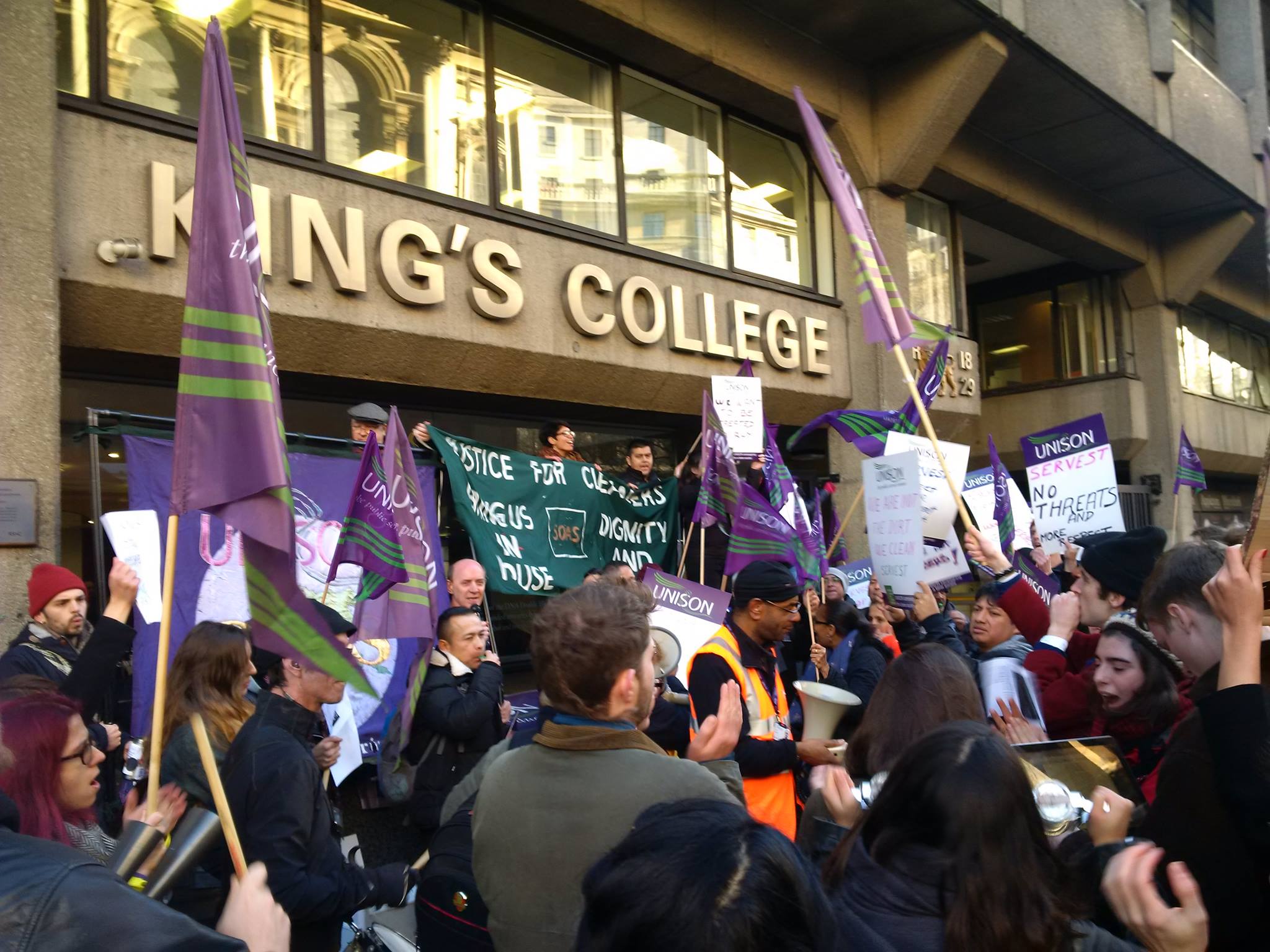
Universities and College Union (UCU)’s Higher Education committee will meet today to plan strike action and discuss recent nationwide ballots concerning pensions, pay and working conditions in UK universities.
In early September, UCU members across the UK were sent ballots inviting votes on two separate issues: one about reforms to pensions and one about about pay and conditions. Of the total number of UCU members who voted nationwide, 79% supported striking over pensions and 74% supported striking over pay and conditions. Meanwhile average nationwide turnout for the pensions ballot was 53%, and on the pay and conditions ballot it was 49%.
UCU general secretary Jo Grady said in a statement yesterday that the results of the two ballots “can only be interpreted as clear support for strike action over pensions, pay and working conditions. The ballots reflect just how unhappy and angry staff are at the state of higher education in the UK.”
Yesterday afternoon, UCU announced that 41 out of 63 branches of universities across the UK had voted to strike over an ongoing pensions crisis, and that 53 of 147 eligible branches had voted to strike over other working conditions issues such as a decline in real-terms pay.
Turnout at KCL narrowly too low for strike action
Just over 80% of the UCU members who voted at KCL supported industrial action in both ballots. However, there is a minimum 50% threshold required by government law for a strike to be valid. The figures reveal that KCL was only 21 votes short of reaching the necessary threshold for striking over pensions, with a turnout of 48.49%. Meanwhile the ballot on pay and conditions was only 17 votes away from being valid, with a turnout of 48.71%. UCU branches at Imperial College, Birkbeck College, London School of Economics also narrowly missed the necessary threshold despite the idea of strikes being popular within the under 50% of members who did vote.
Database frustrations hindering efforts
Dr Stan Papoulias, a site rep for UCU in KCL’s Denmark Hill campus, told Roar News that yesterday’s announcements represent a considerable and encouraging increase from October last year, when the KCL branch was approximately 150 votes away from the necessary 50% voter turnout threshold. They said this testifies the work of activists in getting the vote out. Stan pointed out that administrative issues may play a significant role: in some cases, up to 10% of UCU ballots sent out at KCL were sent to members who were no longer working at KCL. Stan therefore believes that casualised, short-term contracts have made it particularly difficult to maintain an up-to-date database. This, they said, presents another reason for the need to fight against what UCU calls “the scourge of casualisation”. However, efforts to grow the movement will continue. After last year’s pensions stikes, UCU membership at KCL surged by about 50%.
At KCL, the pensions ballot was sent to 1343 UCU members. 539 voted to strike over pensions, and 110 against. And the second ballot concerning working conditions was sent to 1357 UCU members. 535 voted to strike, and 126 against.
The 41 universities whose UCU members will be participating in the upcoming nationwide pensions strike include UCL, City, University of London, Goldsmiths, and Queen Mary, as well as many others including Cambridge, Glasgow, and York. Up to a million students could be affected.
An overview of the crisis over university staff pensions pot
This complex and difficult dispute concerns how to resolve an apparent funding gap in the Universities Superannuation Scheme (USS), one of the UK’s largest private pensions providors. The size and nature of the deficit is disputed, but USS recently calculated it to be £6.6 billion, a significant decrease from £17.5 billion in 2017. USS has a total value of around £72 billion and has around 400,000 members.
USS maintain that, for the next few years at least, it is necessary for both universities and their employees to pay higher annual contributions to de- risk the pensions pot and make it more sustainable. Yet, as USS concede, questions have been raised about the valuation of its deficit, which is based on complex and controversial assumptions about future financial performance of inflation-linked ‘gilts’ and ‘discount rates’. When USS once misrepresented view of The Pensions Regulator about a method of calculating such rates, it was reprimanded by the Regulator.
UCU “represents over 120,000 academics, lecturers, trainers, instructors, researchers, managers, administrators, computer staff, librarians and postgraduates in universities, colleges, prisons, adult education and training organisations across the UK”. It says that the proposed increases in annual contribution levels are too costly. Employees now pay 8.8% of their salary, but USS are pressing for 9.6% then 11% over the next couple of years (in 2011 annual contributions were 6.35%).

After construcitve negotiations broke down in 2017, the pensions dispute came to a head during 14 days of strikes in spring 2018, when an estimated 42,000 staff walked out in protest against their employees’ proposals. This unprecedented industrial action led to a loss of up to 575,000 teaching hours. A recent Freedom of Information request made by Roar revealed that at KCL, 515 students complained to request tuition fee compensation after the spring 2018 strike.
Yesterday’s announcements of the strike ballots are set to drag on the dispute into 2020. Judging from this tweet yesterday, relations between UCU and Universities UK continue to be acrimonious.
About the author