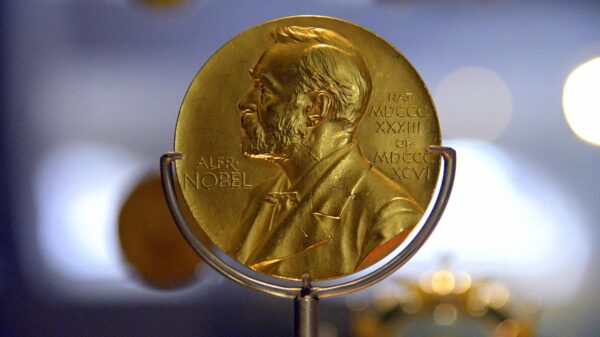

On October 11, 2023, the King’s College London Natural, Engineering and Mathematical Sciences (NMES) department held an event on research at King’s in the fields awarded the 2023 Nobel Prizes in Physics and Chemistry. In the weeks following the event, Roar had the opportunity to interview Kings academics Dr Amelle Zair, Dr Emilio Pisanty, and Dr Margarita Khokhlova on their work in the field.
The 2023 Nobel Prize in Physics was awarded to Pierre Agostini, Ferenc Krausz and Anne L’Huillier, “for experimental methods that generate attosecond pulses of light for the study of electron dynamics in matter.” Dr Amelle Zair, Dr Emilio Pisanty, and Dr Margarita Khokhlova discussed their work and its relationship to the Nobel Prize in Physics that was given to attosecond physics pioneers.
Dr Amelle Zair is the head of the attosecond quantum physics laboratories at King’s College London, and an experimentalist with 15 years of experience in attosecond physics. She was at the forefront of proving that high order harmonic generation was a source of attosecond forces, and has been a long-term collaborator with recent Nobel Laureate L’Huillier. Currently, she is continuing research into dynamical processes and is eager to discover new concepts and paradigms in quantum information as well. Dr Emilio Pisanty and Dr Margarita Khokhlova, theorists, are Royal Society University Research Fellows. Pisanty’s research is focused on the intersections of strong-field physics, structured light, catastrophe optics and quantum optics. Khokhlova’s interests are constantly switching and evolving, largely contributing to new concepts of attosecond sources and pushing the boundaries of their applications.
“The Holy Grail of physics is to resolve ultrafast phenomena…” explains Zair, “you have, for example, Usain Bolt. [He] is a fantastic runner and you want to study his technique and the only way to study his technique is to take snapshot and slow motion of his run to study it. And basically, what I try to do is the same thing with electrons instead. So, electrons are my Usain Bolt and the flash of light or the camera that takes snapshots is my attosecond source.”
Attosecond physics is a fascinating field with plenty of potential applications, ranging from medical diagnostics or studying previously unknown physical phenomena, to biochemistry and pharmacology.
“In general, understanding how electrons move and how nuclei move in molecules, is just a fancy name for chemistry,” says Pisanty, “the more that we can understand how molecules move and how electrons move inside molecules, the more we can understand how to control it. And that tells us a lot.”
“We do excellent research!” laughs Zair when prompted about the group’s research interests, “We combine — which is not always the case — both experiment and theory, which is a strength.”
An interesting feature of the King’s Attosecond Quantum Physics (ATTOKINGS) group is the emphasis on the collaboration between theory and experiment. This aids in faster turnarounds in the research process.
“I think that’s one of the nicest things about attosecond science in general, that the turnaround times are super fast in between an experiment being published […] and providing models and simulations and theory to understand it, or between someone pointing out like hey like here’s an effect, we think it would be cool to measure it and somebody building the light sources and the electron detection apparatus or whatever that’s required and seeing that effect,” says Pisanty on the collaboration between theorists and experimentalists in the field, “[…] That’s something where in other fields, maybe it does happen, but on a timescale of like, 15 years. Whereas in attosecond science, we are a lot faster.”
ATTOKINGs is currently working on a range of research projects within the field. Recently, Khokhlova was awarded a prestigious Royal Society University Research Fellowship worth 1.5-2 million pounds for a project focusing on the expansion of attosecond physics titled: “From the Advance of Attosecond Light Sources to Ultrafast Dynamics of Chiral and Topological Matter and Back Again.”
Moreover, there exists potential applications for attoscience in quantum computing, an avenue the team at King’s has been eagerly exploring.
“I don’t know if we will be able to contribute to this community, but that’s my hope and what I hope is that King’s will be the first to do that,” says Zair about quantum information processing.
The team are optimistic about the fast-growing nature of the field, and are hopeful about students and researchers’ increasing interest in it.
“This is just the beginning. The Nobel Prize is recognising the emergence of attosecond physics. I would say the full application, that is far from over,” says Zair, “[…] I think that it would be fantastic to see these community growing even further through the different generation of students. […] We have lots of different options to explore. So, there is a lot to do now. […] I think [attosecond] physics is really starting to be a central of attraction, and it also can easily, impact other types of physics.”

News Editor. Final-year MSci Physics and Philosophy student at King's College London, with a keen interest in science communication, and the intersection of science, philosophy, and society.