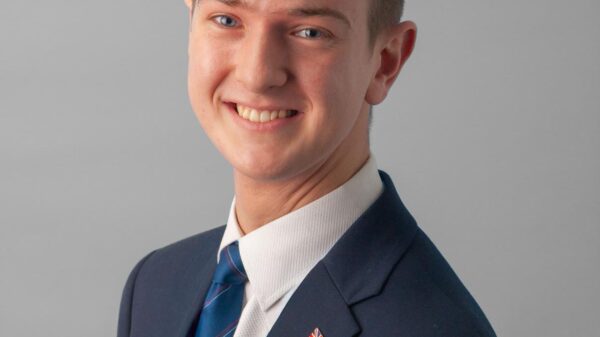

Comment Editor Fintan Hogan sits down with King’s alumni and Member of Parliament Bob Seely, as part of Roar’s ongoing alumni interview series.
King’s College London (KCL) prides itself on many of its alumni. From Nightingale to Tutu, their faces decorate windows and walls all over King’s campuses. But these are old hands in the alumni game. A new generation have graduated and are the changemakers of today. This short series of interviews aims to provide an insight into former students who have taken the short trip from Strand to SW1.
Every interviewee deserves an individual article, as each has a valuable political insight to share. After the staggered releases, we will compile one further piece which summarises the value that former students have taken from King’s in particular. Each has been kind enough to offer introspection, advice and guidance for our current students. Read carefully – these are powerful, popular and intelligent public figures who have stood in your shoes. We are grateful to each participant for their time.
Background
Shortly after interviewing Pensions Minister Alex Burghart, I met with Conservative MP for the Isle of Wight, Bob Seely. Bob, as he asked me to call him, is well-known within Parliament for his comments on Ukraine and for recently going viral for saying “inshallah” on a Sky News interview. Bob is highly-respected on matters of international conflict, having served in the army for around a decade and having completed a PhD on contemporary Russian warfare at King’s. In 2016, he was awarded a military MBE.
— Bob Seely MP (@IoWBobSeely) October 24, 2022
We meet in Portcullis House, which is manned by a “small army of staff” according to Bob. Indeed, the entire courtyard is bustling with MPs, assistants and the workforce required to house and facilitate the business of 650 parliamentarians. I even spy Matt Hancock while waiting in reception. Bob meets me, shakes my hand and offers to buy me a coffee. At first I feel bad accepting, but seeing drink prices of under £1.50 (in central London!), I don’t mind so much. The rich and powerful have never had it so good.
The Arc of Instability
I have a personal reason for being particularly excited for this interview. Meeting any MP is a privilege, but before coming into office, Bob worked as a foreign correspondent for The Times. This is a pretty exciting job for anyone to talk about, but I would love to work in international media in the future myself. So, in practice, I was seeking advice as much for myself as for our dear readers. Bob has also advocated for an expanded BBC World Service, something that I too believe to be important.
Bob tells me that he’s had “three amazing jobs” in his life – journalism, the armed forces and a Member of Parliament. He told me that he “loved” his job at The Times, despite not being “remotely qualified” for it. He was recruited as a foreign correspondent in Kyiv and stayed there during the first half of 1990s, travelling around the ‘arc of instability’ of newly post-Soviet states.
He was recruited following an “educational holiday” to Kyiv on the advice of a friend, who had tipped him off about a couple of stories about Chernobyl and Soviet exploitation. His work was accepted and published by the bureau chief of The Times, who then asked him to remain in-post in Kyiv. In a matter of weeks, Bob moved from writing scandalous gossip pieces in the Sunday Mirror, to a regional staff writer for The Times, based in the collapsing USSR.
Bob tells me that he regrets not getting more out of his time posted in Europe. Specifically, he feels that a book of his time there could have been best-selling, and he regrets not taking or filing notes appropriately. “Getting the breaks,” he advises, requires “working all of your angles.” He recommends diligence in work, because it’s not always clear at the time what specific opportunities will be most important to you down the line.
Contemporary Russian warfare
Bob successfully defended his PhD at King’s in 2021, and is now technically Dr Seely – although he tells me that friends and family sometimes casually tease him as he is not a ‘real’ doctor. He hopes that his thesis and research can now be re-written into a book, and is “talking to a couple of publishers” about realising this soon.
He regrets not moving to publish sooner. “It was more salient if I’d said all of this 5 years ago, 10 years ago, when I should have done,” he says. He would have preferred to be “prescient rather than salient” with his book. But Bob is far more humble than I would be in his position, since he was, in fact, warning of Russian non-recognition of post-Soviet independence as early as 1994 in the Washington Post. The invasion of Ukraine has proven him startlingly correct.
“To say that it was [just] a Putin thing is not true. The Russian state had effectively done a reset under Yeltsin and it’s important that we remember that… I think that there is a huge and extended delusion by the West about what was happening.” He sees the invasion of 2022 as part of a broader Russian “trajectory.” Instances of this ilk might include the invasion of Crimea in 2014 and Georgia in 2008, but I’m sure Bob could name countless more. Putin, he says, has acted to accelerate this trend; it is only because of him that Russian aggression has “as fully and as disastrously” brought war to the region.
I ask about what more we can do to protect vulnerable democracies from autocratic neighbours in the future. Specifically, I am interested in how he compares Russia and China, since he likened their “assertive authoritarianism” in an article in 2020. “Declining powers in many ways present greater threats than rising powers,” he says, suggesting that the Chinese may be more cautious than the Russians have been.
“The harder we are on Russia now, within reason, the more the Chinese will get the message that we will destroy their economy, and do huge damage to the world economy, if they go to war over Taiwan.” He thinks that democratic nations need to set a clear precedent with their treatment of Russia – inflicting political and economic damage which the Chinese government will not want to subject themselves to. However, he suggests that “I still think [the invasion of Taiwan] is more likely than not in the next 20 years… Power corrupts; absolute power corrupts absolutely.”
The Isle
It’s clear that Bob has had a longstanding interest in international relations, but I am curious why he pivoted to domestic politics. Asking when he knew that politics was something he wanted to do, he tells me that it was “when I was watching TV in the 1970s, listening to people from that era like Dennis Healy, and me just shouting at the TV saying “You’re wrong, you’re wrong!””
After that, he “fell in love with politics” and now describes it as a “vocation” – something Max Weber would be proud of. He says that politics has been a family tradition, calling himself “number six” of his paternal line – one of which even held the seat which he now does; MP for the Isle of Wight.
He’s proudest of “getting a better deal for the Isle of Wight,” citing achievements like “getting over £120m additional capital investment for the island.” He recognises that some of this would have been delivered without him, but thinks that his work has helped the island raise this investment from government and private sources.
He is proud of helping to save the Island Line rail route from closure, securing £26m for the project, and Railway Pier, which was another £20m. During my research, I found that Bob was annoyed at the absence of a joined-up approach from ferry and train operators.
Off to Westminster today and yet again, the train pulls out of Lymington Pier as ferry arrives. Unacceptable lack of coordination from both @SW_Help + @wightlinkferry. pic.twitter.com/hCDKm36qMq
— Bob Seely MP (@IoWBobSeely) August 16, 2022
There are proposals ready, he tells me, but he has “got to wait until a transport bill comes up so I can throw some amendments in.” He is as frustrated about the transport links in-person as he was online: “The Victorians did integrated transport frankly better than we do.”
But he’s keen to keep the island moving forward. He emphasises the need to be the “first in the queue” for new technologies and pilot schemes, such as the trial of the covid tracker app on the island. The island is more self-contained and measurable than other areas of the UK, which Bob says makes it ideal for agencies and corporations to test new initiatives there.
“Have you seen ‘Talladega Nights: The Ballad of Ricky Bobby’?” he suddenly asks, changing track. “No,” I tell him, slightly perplexed at the unexpected pop culture quiz. “You haven’t lived,” he jokes, telling me that according to him, it is one of Will Ferrell’s better films. (Roar would like to offer Mr Ferrell a right of reply.)
“If you’re not first, you’re last” he quotes. He sees the Isle of Wight as either at the forefront of new government policy, or left as an afterthought, once the political will and pot of money have both dried up. He tells me that he will continue to do everything he can to keep his constituency at the front of the queue.
Looking ahead
I ask what he hopes to do better in his work for his constituents moving forward. “I need to get a better funded settlement for the council,” he says. He’s also seeking an island designation for the Isle of Wight as a protected landscape, as well as representation from the Tate and Royal Academy on the island. “We have an extraordinary artistic heritage which we have forgotten about,” he says.
Bob is still relatively fresh into Parliament, having first been elected as an MP in 2017. Does he have eyes on the front bench? “I haven’t got a clue if I’m ever going to get a government job, be a minister. I can never control that. There are good sides to being a minister but there are bad sides too.” He is glad that he can be open and honest about his political positions, not constrained by Cabinet’s collective responsibility, but recognises that backbenchers have “less power to change things.”
All in all, he tells me that he aims to be “as good a parliamentarian as I can be,” and would be “pretty chuffed” is ‘all’ he ever does is be MP for the Isle of Wight. He calls it “the best job in the world.”
It would have been remiss of me to neglect the turbulence of the contemporary political situation during our interview. At this time Liz Truss was on her last legs (resigning less than 48 hours after our interview) and her government was falling apart after a series of U-turns. Bob had supported Truss in the final two against Sunak, but Penny Mordaunt up until that point – something he did again in the brief October race.
"We need to find a unity candidate" – @IoWBobSeely on why he backs #PM4PM. pic.twitter.com/VvKFDxLR95
— Penny Mordaunt (@PennyMordaunt) October 23, 2022
He didn’t think that supporting Truss in the last two had been a mistake, but agreed that her economic policy had “probably” gone ‘too far and too fast’. I ask if Truss had, at that time, his full support. This question is rather defunct, since Rishi Sunak is now PM, but his answer was interesting nonetheless. “We need to get our act together,” he told me. When I ask “how?”, he said that “we shouldn’t be repeatedly replacing leaders but… we need to sort this pretty quickly. So yeah, I’ll support her but she needs to get her act together.”
He also told me that he would not be voting for a general election any time soon, as his 118,000-person constituency was disproportionate. There would be an “inequality of representation” if an election is called prior to new boundaries being approved, and he suggested that upcoming reviews were necessary to fix the issue.
Roar thanks MP Bob Seely and Parliamentary Assistant Alex Fynney for their time.